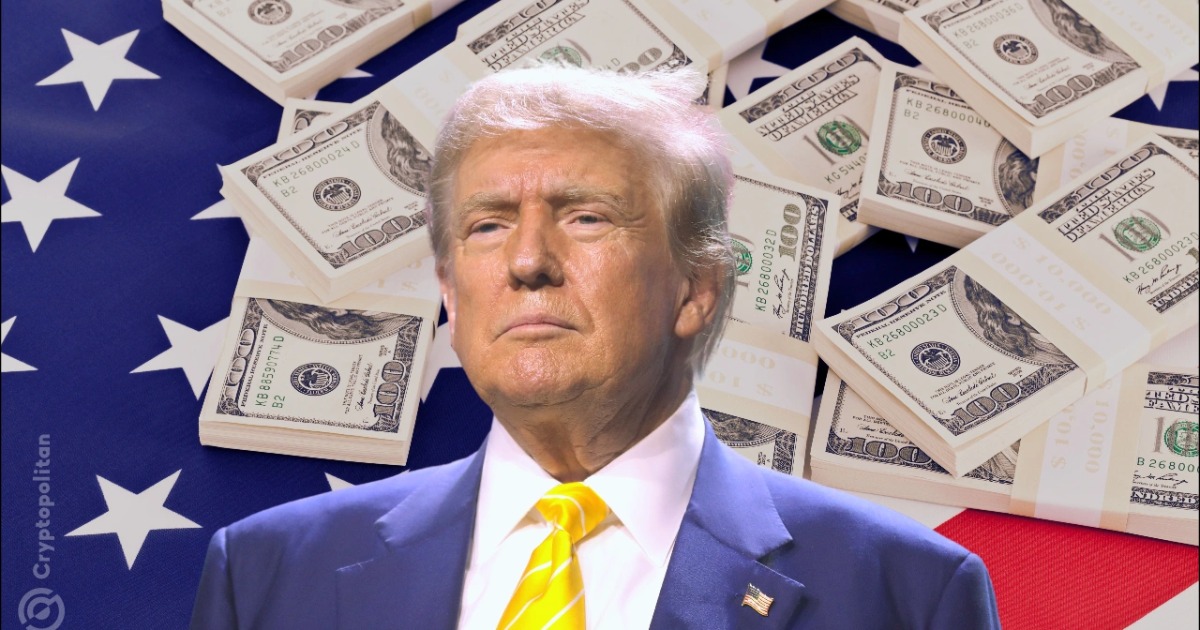
The White House has faced questions about Donald Trump's promise to send $5,000 checks to American adults following the Republican Party's defeat in the 2026 midterm elections.
Throughout October, the president repeatedly promoted the possibility of substantial cash payments, suggesting that millions of Americans could benefit if Republicans maintained control of Congress.
However, the November 3 elections delivered a sweeping victory for Democrats, who secured control of both the House of Representatives and the Senate.
That outcome has raised serious questions about the future of Trump's proposed payments, particularly because he had explicitly linked them to Republican electoral success.
CNN has now questioned the White House about whether the checks are still being considered, while Vice President JD Vance has offered his own explanation for the party's disappointing results.
And the administration's response has left the future of the proposed payments uncertain.
What did the White House say about Trump's $5,000 checks?
According to CNN reporting published on November 6, the White House declined to provide a direct answer when asked about the status of Trump's $5,000 payment proposal.
White House spokesperson Matthew Middleton was questioned about the checks and several other promises the president had made during his midterm campaign appearances.
Rather than confirming whether the administration would proceed with the payments, Middleton issued a broader statement about Trump's economic priorities.
"Moving forward, the President will work with anyone willing to advance solutions that strengthen our economy," Middleton said.
He added: "We hope Democrats will put the American people first and join us in that effort."
However, the statement did not specifically address whether Americans would receive the promised $5,000.
When CNN pressed the White House to clarify whether Trump had officially abandoned the idea, the administration did not respond.
That lack of clarification has left the proposal's future unresolved.
As of the November 6 report, Trump had also not publicly addressed whether the payments would continue to be pursued following the election.
What did Donald Trump originally promise Americans?
During the weeks leading up to the November 3 midterms, Trump repeatedly suggested that Americans could receive $5,000 checks if Republicans retained control of Congress.
The president made the proposal during campaign rallies across several states, presenting it as a benefit that would become possible under continued Republican leadership.
Speaking at a rally in Kalispell, Montana, Trump said he believed the country's economic performance made such a proposal possible.
He then attached an explicit political condition to the promise.
"If Republicans can win the House of Representatives and the US Senate, I am going to give all adult citizens of the United States of America, $5,000 a year," Trump told supporters.
He also claimed that only a Republican president could deliver such payments.
The reference to $5,000 a year attracted particular attention because it suggested an ongoing annual benefit rather than a single one-time payment.
However, the administration did not establish a funded, legally authorised payment programme before the election.
No application process, official eligibility system or payment schedule was announced.
Are Americans still getting the $5,000 checks?
There is currently no confirmed $5,000 payment programme for American adults.
Trump's original promise was conditional on Republicans winning control of both chambers of Congress, something they failed to achieve in the November 3 elections.
However, the White House has not explicitly confirmed that the proposal has been cancelled.
Its refusal to provide a direct answer means the administration's intentions remain unclear.
Any large-scale federal payment programme would also require a viable legal and funding mechanism, with congressional approval generally necessary for new federal spending of this kind.
With Democrats set to control Congress, passing a major new payment proposal could prove politically difficult.
Americans should therefore not treat the campaign promise as confirmation that money will be deposited into their accounts.
There is no verified claim portal or government application for the proposed $5,000 checks.
What has JD Vance said following the midterm elections?
Vice President JD Vance addressed the Republican Party's electoral defeat in a statement posted on X on November 4.
His remarks focused on why voters had turned away from the party despite supporting Trump and Vance in the 2024 presidential election.
Vance argued that several issues had contributed to the result, including the administration's ongoing war with Iran.
He suggested that polling indicated some previous Republican voters had switched their support to Democratic candidates.
According to Vance, concerns about the Iran conflict, inflation, living costs and the administration's foreign policy had influenced voters.
He also identified dissatisfaction with the government's approach to its America First agenda and its relationship with Israel.
The vice president argued that Republicans needed to take those concerns seriously when examining their electoral performance.
Trump subsequently described Vance's assessment as largely accurate while defending his administration's decisions.
However, Vance's comments did not establish a new policy concerning the $5,000 checks.
Why did Republicans lose the midterm elections?
The 2026 midterm elections resulted in substantial Democratic gains across the United States.
Democrats secured control of both chambers of Congress, dealing a major political setback to Trump's administration.
Throughout the campaign, voters had expressed concerns about economic conditions, including the cost of living and the consequences of the Iran conflict.
Vance's post-election statement suggested that these issues had played an important role in the outcome.
However, election results can reflect numerous factors, including candidate quality, turnout, local political conditions and broader public attitudes towards the administration.
The vice president's interpretation represents one assessment of the defeat rather than a definitive explanation of every race.
For Trump, the result has created a more difficult political environment for the remainder of his presidency.
What other promises did Trump make before the election?
The $5,000 checks were not the only commitment Trump linked to Republican victories.
According to CNN, the president made several other promises during his October campaign appearances, particularly in states with competitive Senate races.
These included commitments concerning water contamination claims in North Carolina, investment in a drug manufacturing facility in Kentucky and agricultural fuel availability in Kansas and Iowa.
Trump also discussed continued federal assistance for Alaska.
One particularly controversial promise involved compensation for people affected by contaminated water at Camp Lejeune in North Carolina.
During an October 20 rally in Greenville, Trump said he would direct the Department of Justice to settle remaining legitimate claims if Republicans won both chambers.
He also suggested that the money would not be available if Republicans lost.
However, the availability of compensation for eligible claimants is governed by federal law and the relevant claims process, not simply by which party wins an election.
CNN reported that the White House had not provided specific updates on the status of these promises following the Democratic victory.
Did Trump face criticism over the proposed payments?
Yes. Trump's $5,000 promise attracted criticism from political opponents and some figures within his own party.
Critics argued that explicitly linking direct cash payments to electoral victories risked turning a government spending proposal into a campaign incentive.
Outgoing Republican Senator Thom Tillis described the proposal as a gimmick and questioned whether it would address the country's underlying economic problems.
Fox News presenter Laura Ingraham also challenged Trump about why the administration could not distribute the payments before the election.
During a September interview, she asked why Americans would need to wait if the president believed the checks were affordable.
Trump responded by arguing that the payments could not be delivered under the circumstances he described, before criticising Democrats.
However, the president did not provide a detailed legislative or funding plan explaining how the proposed annual payments would operate.
Could Trump still introduce the $5,000 checks?
It remains possible for the administration to propose legislation or negotiate with Congress over direct financial assistance.
However, there is a significant difference between announcing a political ambition and establishing an actual government benefit.
For a new federal payment programme to proceed, officials would need to determine how it would be funded, who would qualify and how the money would be distributed.
Congress would also need to provide the necessary legal authority and funding where required.
Trump's original promise was made in the context of a Republican-controlled Congress, and the election result has substantially changed that political calculation.
Although the president has said he is willing to work with Democrats on economic issues, no bipartisan agreement concerning the proposed $5,000 payments has been announced.
What should Americans do if they are waiting for the money?
For now, Americans should be cautious about any suggestion that the $5,000 checks have been approved or that payments are about to begin.
There is no confirmed distribution date, application deadline or eligibility list for the proposal.
Anyone encountering websites or social media posts claiming to offer early registration should verify the information through official government channels.
Scammers sometimes exploit publicity surrounding proposed government payments by creating fake application websites or requesting personal and financial information.
Legitimate federal payment programmes are normally announced through official government agencies with clear eligibility requirements.
Until such an announcement is made, the proposed checks remain a campaign promise rather than an established benefit.
What happens next?
The White House's response to CNN has left one central question unanswered: does Donald Trump still intend to pursue the $5,000 payments after Republicans lost Congress?
Despite being asked directly, the administration did not confirm whether the proposal would proceed or be abandoned.
JD Vance, meanwhile, has acknowledged significant political challenges facing Republicans following the election and identified several issues he believes contributed to their defeat.
With Democrats preparing to control both chambers of Congress, the administration now faces a more complicated path towards implementing major new spending proposals.
For millions of Americans who heard Trump's promise during the campaign, the most important point is that no $5,000 checks have been authorised or scheduled for distribution.
Whether the president revisits the proposal in the coming months remains to be seen.