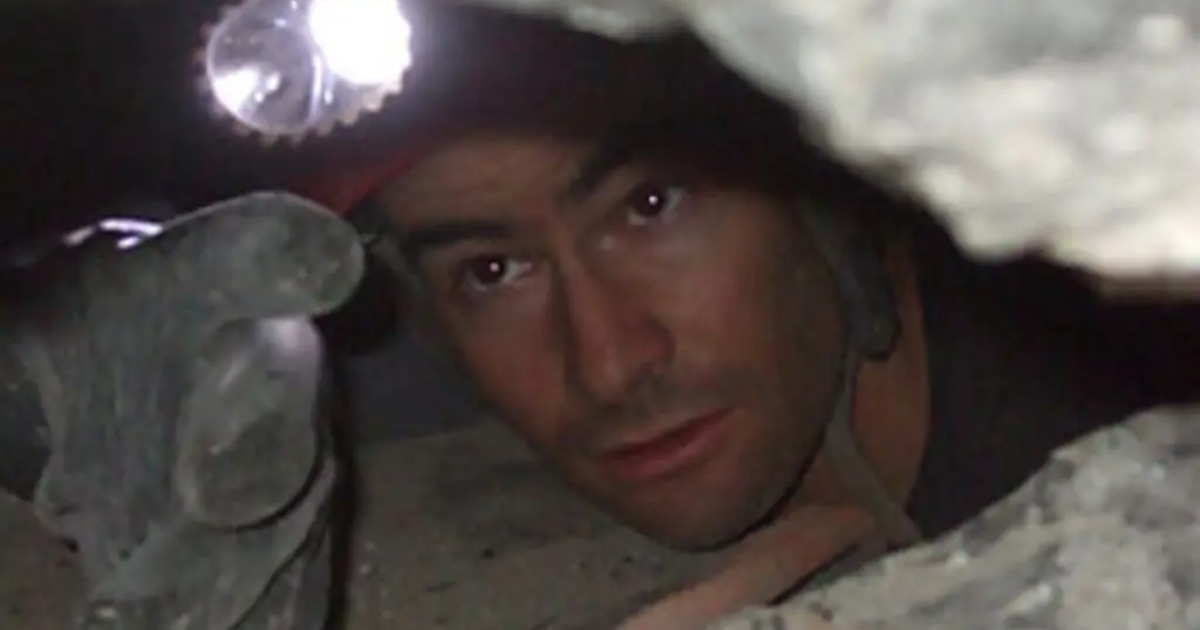
Footage from one of America's most devastating caving tragedies has resurfaced, offering a disturbing insight into the desperate efforts to save a young father who became trapped underground.
John Edward Jones was just 26 years old when a family outing in Utah ended in tragedy in November 2009.
The former University of Virginia medical student had been exploring Nutty Putty Cave during a Thanksgiving visit when he became trapped in a narrow underground passage.
Rescue teams spent more than a day attempting to reach and free him, but the conditions inside the cave made the operation extraordinarily difficult.
Now, footage reportedly captured by the Utah County Sheriff's Office has offered another perspective on the challenges faced by rescuers.
The recording does not show Jones dying, but it reveals just how confined the passages were and how difficult it was for emergency workers to manoeuvre equipment into position.
What happened to John Edward Jones in Nutty Putty Cave?
On November 24, 2009, Jones entered Nutty Putty Cave in Utah while spending time with family over the Thanksgiving holiday.
He was accompanied by a group of relatives and other explorers.
During the outing, Jones became separated from the others and entered a particularly narrow passage headfirst.
According to accounts of the incident, he believed he was exploring a route through the cave but instead entered a constricted section from which he could not easily retreat.
After travelling approximately 30 feet into the passage, he slipped into an extremely tight gap and became wedged in place.
His body was positioned headfirst on a steep downward slope, leaving him unable to turn around or push himself back out.
What began as a recreational trip quickly became a major rescue emergency.
Why was Jones trapped upside down?
The passage was so narrow that Jones had very little room to move his arms, legs or torso.
He was positioned at a steep angle, with his head below his feet.
That orientation made the situation especially dangerous because remaining inverted for an extended period can interfere with normal breathing and circulation.
Rescuers faced the challenge of extracting a trapped adult through a passage barely wide enough for a person to squeeze through.
They also had to work within the cave's confined spaces while attempting to avoid causing further injury.
Jones could not simply be pulled backwards because of the position of his body and the surrounding rock.
As the hours passed, the prolonged inverted position placed increasing strain on his body.
What does the rescue footage show?
The footage, discussed in a November 13, 2026 report by VT, shows rescuers navigating the cave's extremely narrow passages and assessing the obstacles preventing them from reaching Jones.
The recording reportedly includes conversations between emergency workers as they discuss possible extraction methods.
At one point, a rescuer explains that removing a substantial section of rock would be necessary to create enough room for the operation.
The footage also shows the difficulty of moving through the passage, even for rescuers who were not trapped.
One responder describes the steepness of the underground route, estimating that the passage descends at an angle of approximately 60 to 70 degrees.
The recording provides an unusually close view of the conditions rescue teams were forced to work in.
However, it does not show Jones's face, the exact moment he became trapped or his death.
Why couldn't rescuers simply break the rock around him?
One of the major challenges was the limited space available for tools and rescue equipment.
Workers were attempting to operate in a passage where even repositioning their bodies was difficult.
According to the recorded discussion, some rock had already been removed in an effort to improve access.
However, rescuers explained that a much larger and thicker section would need to be removed to create sufficient clearance.
Breaking away substantial amounts of rock in such a confined environment presented additional practical and safety challenges.
Any attempt to enlarge the passage also had to account for the risk of falling debris and further movement around the trapped caver.
The footage illustrates why the operation was far more complicated than simply attaching a rope and pulling Jones free.
How long was John Jones trapped?
Jones remained trapped for approximately 27 hours before his death.
Throughout the rescue, emergency workers attempted to develop a method of safely extracting him from the passage.
Teams worked in shifts, navigating the difficult underground environment while trying to manoeuvre rescue equipment into position.
One attempted extraction involved a rope-and-pulley arrangement intended to help move Jones upward.
However, the effort ultimately failed, and rescuers were unable to free him.
His prolonged inverted position and the physical strain of being trapped contributed to the fatal outcome.
Despite the extraordinary efforts of the rescue teams, Jones died on November 25, 2009.
What happened to Nutty Putty Cave after his death?
Following the tragedy, authorities made the decision to permanently close Nutty Putty Cave.
Recovering Jones's body was considered too dangerous because of the exceptionally narrow passage and the risks involved in another extraction attempt.
His remains were left inside the cave.
The entrance was subsequently sealed to prevent further exploration and reduce the risk of another tragedy.
The cave remains closely associated with the incident, which continues to be discussed in caving safety circles and online documentaries.
Why has the footage attracted attention again?
The video has renewed interest in the rescue because it allows viewers to better understand the physical conditions that confronted emergency workers.
Descriptions of the incident have circulated for years, but the footage provides a more immediate perspective on the narrowness and steepness of the underground passages.
It also captures rescuers discussing their options as they attempted to reach Jones.
For people unfamiliar with caving, the recording illustrates how difficult an underground rescue can become when a person is trapped beyond an exceptionally tight section.
Importantly, the footage should not be confused with a recording of Jones's actual death.
The available report describes it as footage of the rescue operation rather than the final moments of his life.
What can be learned from the Nutty Putty Cave tragedy?
The incident remains a reminder of the dangers posed by narrow, unfamiliar underground passages.
Even experienced rescue teams can face severe limitations when attempting to reach someone trapped in a confined space.
Caving safety guidance generally emphasises understanding the route, avoiding passages beyond one's ability and never forcing entry into a constriction without knowing whether retreat is possible.
Explorers should also travel with appropriate equipment, experienced companions and a clear emergency plan.
For Jones's family, the tragedy represented an unimaginable loss during what was supposed to be a holiday spent together.
More than 15 years later, his story continues to resonate, while the rescue footage serves as a stark record of the determination of those who tried to save him.
Source: VT, November 13, 2026, reporting on footage attributed to the Utah County Sheriff's Office. The footage described in the report documents rescue efforts and does not show Jones's death.