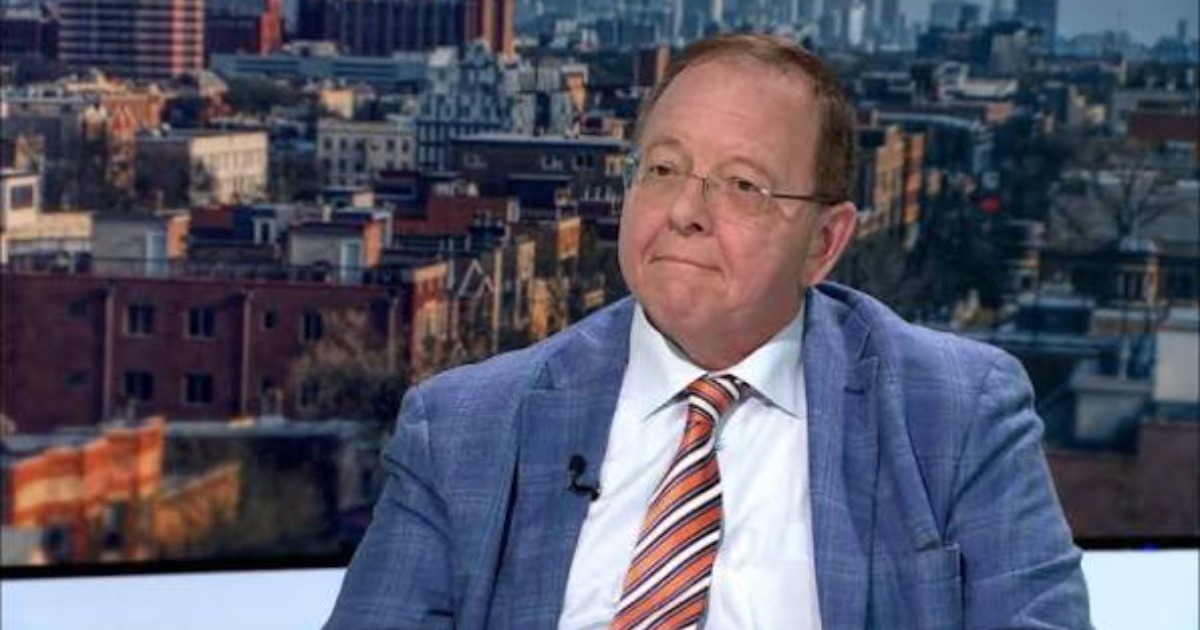
A former White House adviser has issued a stark warning about the eight weeks following the US midterm elections, suggesting that a combination of political instability and international conflicts could create an exceptionally dangerous period.
Robert Pape, a political science professor at the University of Chicago who previously advised the Obama administration, shared his concerns during an appearance on Steven Bartlett's The Diary of a CEO podcast.
The professor, who has spent decades studying political violence and international conflict, argued that several major developments could converge before the beginning of 2027.
His warning comes after Democrats secured control of both chambers of Congress in the November 2026 midterm elections, changing the political landscape for President Donald Trump's remaining time in office.
However, Pape's concerns extend far beyond American domestic politics.
He identified three developments that he believes could interact in ways that increase the risk of political violence and international military escalation.
What was the former White House adviser's eight-week warning?
Speaking on The Diary of a CEO, Pape warned that the period between the November elections and the seating of the new Congress in January could prove particularly unstable.
He described the coming weeks as potentially among the most dangerous of people's lives, arguing that the United States was becoming increasingly caught in what he called an "escalation trap".
The professor explained that this occurs when political or military leaders respond to setbacks by increasing pressure, potentially creating a cycle that becomes progressively harder to escape.
According to Pape, three issues are particularly important: the transfer of congressional power following the midterms, the possibility of further US military action against Iran, and the ongoing Russia-Ukraine war.
He believes these developments could overlap, creating additional pressure on governments already facing significant challenges.
His comments were a warning about potential scenarios, rather than a claim that a particular attack or global conflict was certain to occur.
Why are the US midterm elections part of his warning?
The first concern involves the political transition following the 2026 midterm elections.
Democrats won control of the House of Representatives and Senate, meaning Trump will face a Congress controlled by the opposing party when newly elected lawmakers take office in January 2027.
That change could affect the administration's ability to pass legislation and increase congressional scrutiny of presidential decisions.
Pape argued that periods involving the transfer of political power can become particularly sensitive when public divisions are already pronounced.
During the interview, he drew comparisons with the aftermath of the 2020 presidential election.
That election was followed by disputes over the results and the January 6, 2021, attack on the US Capitol, when supporters of Trump attempted to disrupt the certification of Joe Biden's victory.
Pape suggested that the period between an election and the formal transfer of power deserves particular attention because political tensions can intensify during that interval.
However, the 2026 midterms involve a change in congressional control rather than the presidency itself, meaning the constitutional circumstances differ from those of January 2021.
Trump remains president, while the newly elected members of Congress are due to take office in January.
What did Pape say about the possibility of further conflict with Iran?
The second issue identified by Pape concerns the ongoing confrontation involving the United States and Iran.
During the podcast, he discussed the possibility of further American military strikes and warned that an additional bombing campaign could trigger a wider cycle of retaliation.
He referred to a proposed three-day campaign against Iranian targets, describing the risks he believed could accompany such an operation.
According to his assessment, military action that initially appears limited could create pressure for additional strikes if it fails to achieve its objectives.
Iranian retaliation could then produce further American responses, potentially extending the confrontation beyond its original scope.
Pape warned that such a process could leave the United States involved in a prolonged conflict that becomes increasingly difficult to end.
However, his discussion of possible future strikes should not be interpreted as official confirmation that the administration has authorised a specific new operation.
Military decisions and their consequences remain subject to developments that cannot be established from the interview alone.
How could the Russia-Ukraine war increase the danger?
The third concern involves Russia's continuing invasion of Ukraine and the possibility of further escalation involving European countries.
Pape argued that European governments were increasingly concerned about the direction of the conflict, particularly the possibility of attacks extending beyond conventional military operations.
He highlighted cyberwarfare as one potential route through which tensions could increase.
Cyberattacks against critical infrastructure, communications networks or essential services could create pressure for governments to respond.
The professor suggested that a particularly serious Russian cyberattack could lead European countries and the United States to consider retaliatory action.
He warned that direct military confrontation between Russia and NATO countries would represent a major escalation.
However, cyber incidents vary considerably in their severity, attribution and consequences. An individual cyberattack would not automatically trigger a military response or a wider war.
The danger described by Pape depends on a series of possible decisions and reactions rather than an inevitable sequence of events.
Did the former adviser warn about World War Three?
Yes. During the interview, Pape discussed how escalating confrontations between major military powers could develop into a much broader international conflict.
He explained that a world war would involve leading powers directly attacking one another's territories and armed forces.
His concern was that separate crises could become connected if governments responded to threats or attacks with increasingly forceful measures.
For example, an escalation involving Russia and European NATO members could significantly change the nature of the Ukraine conflict.
Similarly, a prolonged confrontation involving the United States and Iran could create further regional instability.
Pape's argument was that several dangerous situations occurring simultaneously could increase the risk of miscalculation.
He did not establish that World War Three is imminent or that any of the scenarios he described will necessarily happen.
His comments represent an expert assessment of possible risks, not a prediction supported by certainty about future events.
What is an escalation trap?
The concept of an escalation trap is central to Pape's analysis.
In international relations, escalation can occur when one side increases the intensity of a confrontation and the opposing side responds with its own additional measures.
Each side may believe that applying greater pressure will force the other to retreat.
However, the resulting exchanges can instead make compromise more difficult, particularly when political leaders believe that backing down would damage their credibility or security.
This dynamic can occur in military conflicts, economic confrontations and other disputes involving powerful states.
Pape believes the risk is especially significant when several separate confrontations unfold at the same time.
Nevertheless, escalation is not unavoidable. Governments can pursue negotiations, establish communication channels and adopt measures intended to prevent further confrontation.
Why did Pape single out the next eight weeks?
The eight-week period broadly covers the interval between the November 3 midterm elections and the beginning of the new congressional term in early January 2027.
During that time, election results are finalised, incoming lawmakers prepare to take office and political parties adjust to the new balance of power.
Pape argued that this transition could coincide with decisions involving Iran and developments in Ukraine.
He believes the overlap could make the period unusually sensitive.
However, the eight-week timeframe does not represent an official emergency deadline or a confirmed schedule for military action.
It is the period Pape identified as particularly concerning in his own analysis.
Should Americans be worried about the warning?
Pape's comments highlight genuine areas of international tension, but they should be understood in context.
The professor has extensive experience researching political violence and conflict, and his assessment reflects that background.
However, even experienced analysts cannot know with certainty how political leaders will respond to future developments.
Warnings about possible escalation are not the same as official announcements of an impending attack.
There is also no basis for assuming that every scenario discussed in the podcast will occur.
For members of the public, official government announcements and emergency management agencies remain important sources of information about immediate safety concerns.
Following developments through established news organisations can also help distinguish confirmed events from speculation.
What could happen as 2027 approaches?
The coming weeks will see the United States prepare for a new Congress while international conflicts continue to develop.
Trump's administration will face a different political environment once Democrats assume control of both chambers.
Meanwhile, decisions made by the United States, Iran, Russia, Ukraine and European governments could influence the direction of ongoing conflicts.
Pape's central concern is that these developments may not remain entirely separate.
He believes simultaneous political and military pressures could increase the possibility of escalation, particularly if leaders respond to setbacks by taking more aggressive action.
Whether that happens will depend on decisions that have yet to be made.
For now, his eight-week warning is best understood as a caution about overlapping risks rather than confirmation that a global catastrophe is approaching.
Sources: Robert Pape's interview on The Diary of a CEO, published November 5, 2026; VT, November 8, 2026. The scenarios discussed are Pape's assessments and should not be interpreted as confirmed future events.