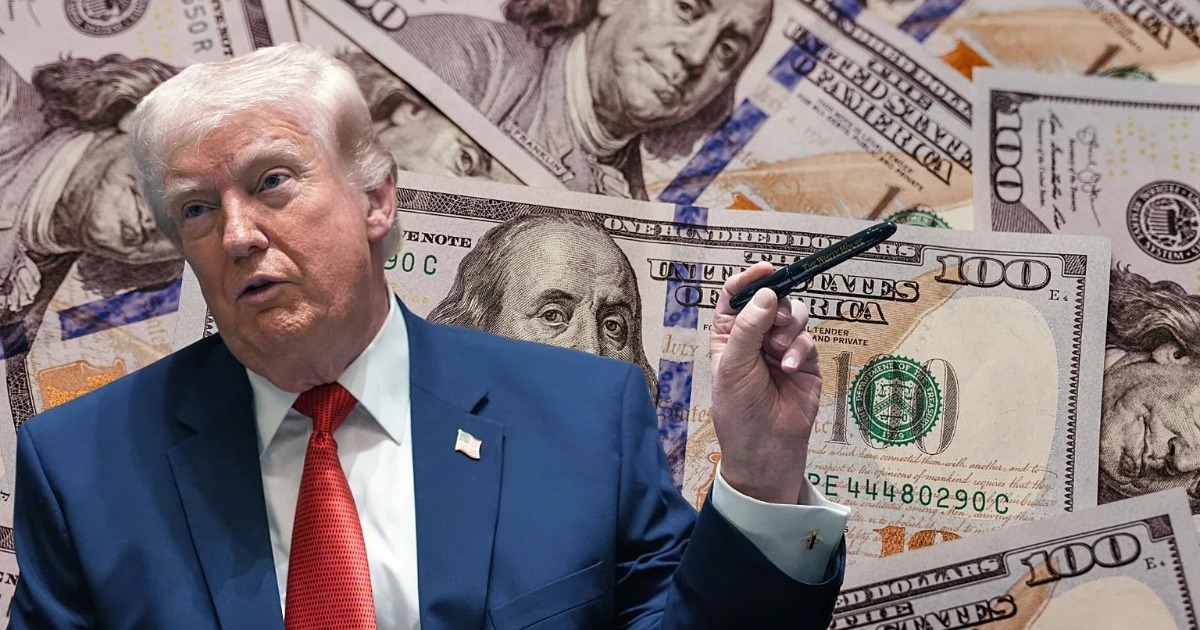
The White House has responded to questions about President Donald Trump's election promises, including his proposal to send $5,000 checks to American adults, following the Republican Party's defeat in the 2026 midterm elections.
Throughout the campaign, Trump made a series of high-profile pledges that he repeatedly linked to Republicans maintaining control of Congress.
Among the most significant was a proposal to distribute $5,000 payments to adult American citizens, a promise that attracted considerable attention from voters hoping for additional financial relief.
However, with Democrats now set to take control of both chambers of Congress in January, questions have emerged about whether the president intends to pursue the proposals.
CNN approached the White House for clarification, and its response has raised further questions about the future of the promised payments.
What did the White House say about Trump's $5,000 checks?
According to CNN's November 6 report, White House spokesperson Matthew Middleton was asked for updates on Trump's proposed payments and several other promises made during the midterm campaign.
Rather than providing specific information about the proposals, Middleton issued a statement focusing on the administration's broader economic priorities.
He said: "Moving forward, the President will work with anyone willing to advance solutions that strengthen our economy. We hope Democrats will put the American people first and join us in that effort."
Crucially, the statement did not confirm whether the proposed $5,000 checks would still be pursued.
CNN subsequently asked whether Trump had officially abandoned the payment proposal.
The White House did not respond to that follow-up question.
That means the administration has neither confirmed that the checks will go ahead nor formally announced that the proposal has been cancelled.
As of the November 6 report, there was no approved nationwide $5,000 payment programme, application process or confirmed distribution date.
What exactly did Trump promise Americans?
Trump introduced the idea of a $5,000 payment during the Republican midterm campaign, presenting it as a potential financial benefit if his party retained control of both chambers of Congress.
The proposal was sometimes described as a "Trump dividend".
During a September appearance at the Republican midterm convention in Dallas, Trump promised a $5,000 payment to adult American citizens if Republicans won the House and Senate.
He also indicated that the money would have to be spent within the United States.
Trump repeated the pledge during subsequent campaign appearances, including an October rally in Kalispell, Montana.
At that event, he argued that the payments would be possible under continued Republican leadership.
The president presented the proposal as a reward for maintaining Republican majorities, although he did not provide a detailed funding mechanism or legislative timetable.
The idea immediately generated questions about how the federal government could finance payments of that size.
With hundreds of millions of American adults potentially eligible, the overall cost could exceed $1 trillion.
Any such programme would require substantial federal funding and would likely need congressional approval.
Have Trump's $5,000 checks been cancelled?
There has been no official confirmation that the proposed payments have been cancelled, but there has also been no confirmation that they will proceed.
That distinction is important because the original pledge was explicitly conditional on Republicans winning the midterm elections.
Democrats won control of both the House of Representatives and the Senate, meaning the condition Trump repeatedly attached to the proposal was not met.
However, the election outcome does not automatically prevent the president from introducing a similar proposal in the future.
Trump could theoretically seek congressional support for payments under a different arrangement, although no such plan had been announced in the CNN report.
Until the administration provides further details, Americans should not assume that the $5,000 payments are guaranteed.
There is currently no official application to complete or payment schedule to follow for the proposed Trump dividend.
What other promises did Trump make before the midterms?
The proposed checks were only one part of a broader series of pledges made during Trump's October campaign appearances.
Several promises focused on issues affecting voters in states with competitive Senate elections.
According to CNN, the president discussed resolving outstanding claims connected to water contamination at Camp Lejeune in North Carolina.
He also promised investment in a pharmaceutical manufacturing facility in Kentucky.
Other pledges involved making a fuel commonly used by farmers more readily available in Kansas and Iowa, alongside continuing federal assistance in Alaska.
In several cases, Trump suggested that the future of those commitments depended on Republican electoral success.
However, the White House's November 6 response did not provide individual updates on those proposals.
What did Trump promise Camp Lejeune victims?
One of the most notable promises involved people seeking compensation for historical water contamination at Marine Corps Base Camp Lejeune in North Carolina.
For decades, contaminated drinking water at the military installation exposed service members, their families and civilian workers to potentially harmful chemicals.
Federal legislation subsequently created a legal pathway for certain affected individuals to pursue compensation.
During an October 20 rally in Greenville, North Carolina, Trump promised to direct the Department of Justice to settle outstanding legitimate claims as quickly as possible if Republicans retained control of Congress.
He also suggested that a Republican defeat would affect the availability of money for settlements.
However, the legal process for Camp Lejeune claims is not automatically eliminated by a change in congressional control.
At the time of Trump's remarks, the White House pointed to what it described as $1 billion in settlements already delivered by the administration.
Following the midterms, CNN reported that the White House had not provided a new update on the president's campaign pledge.
Has Trump commented on the promises since the election?
According to CNN's November 6 reporting, Trump had not publicly addressed the future of his midterm campaign pledges in the days following the election.
That included the proposed $5,000 payments and the commitments he made to voters in individual states.
The president had made public appearances and participated in telephone interviews after the results became clear.
However, those appearances had not produced an explanation of whether his administration intended to continue pursuing the promises.
The lack of clarity has left questions about the proposed payments unanswered.
Why did the $5,000 promise face criticism?
Trump's proposal attracted criticism even before voters went to the polls.
Some opponents questioned whether the payments were financially realistic, while others objected to linking a proposed government benefit to the electoral success of one political party.
Outgoing Republican Senator Thom Tillis was among those who expressed reservations, describing the proposal as a "gimmick" that would not address underlying economic problems.
Other critics questioned why the administration could not pursue the payments while Republicans still controlled Congress.
Fox News presenter Laura Ingraham raised that issue with Trump in September, asking why the checks could not be distributed immediately.
Trump responded by suggesting that the payments could not happen at that point and continued criticising Democrats.
Supporters of the proposal, meanwhile, presented it as a way to return money to American households.
But the central questions surrounding its cost, funding and implementation remained unresolved.
Could Americans still receive $5,000 checks in 2027?
It remains possible for the administration or members of Congress to propose legislation involving direct payments to Americans.
However, there is an important difference between a campaign pledge and an authorised government payment programme.
For the proposed $5,000 checks to become reality, lawmakers would need to address how the programme would be funded, who would qualify and how the payments would be distributed.
Congress would also need to approve any legislation necessary to authorise the spending.
With Democrats taking control of Congress in January 2027, any future proposal would have to navigate a different political environment.
That does not establish whether the payments will or will not happen, but it means the original campaign pledge cannot be treated as an approved benefit.
What happens next for Trump's election promises?
The immediate question is whether Trump or the White House will provide a more detailed explanation of which campaign commitments remain administration priorities.
For the $5,000 checks specifically, Americans are still waiting for confirmation of whether the proposal will be pursued at all.
The White House's response to CNN offered no specific commitment, while its failure to answer a follow-up question left the possibility of cancellation unresolved.
For now, the most important distinction is that the checks have not been officially approved, and no payments have been scheduled.
Anyone encountering websites claiming to offer registration for the proposed $5,000 Trump dividend should be cautious, as no official application programme has been announced.
Further announcements from the White House, Treasury Department or Congress would be needed before Americans could expect such payments.
Until then, Trump's headline-grabbing midterm promise remains an unresolved proposal rather than a confirmed government benefit.
Sources: CNN, Kit Maher, November 6, 2026; CNN reporting on the September 2026 Republican midterm convention; Associated Press.