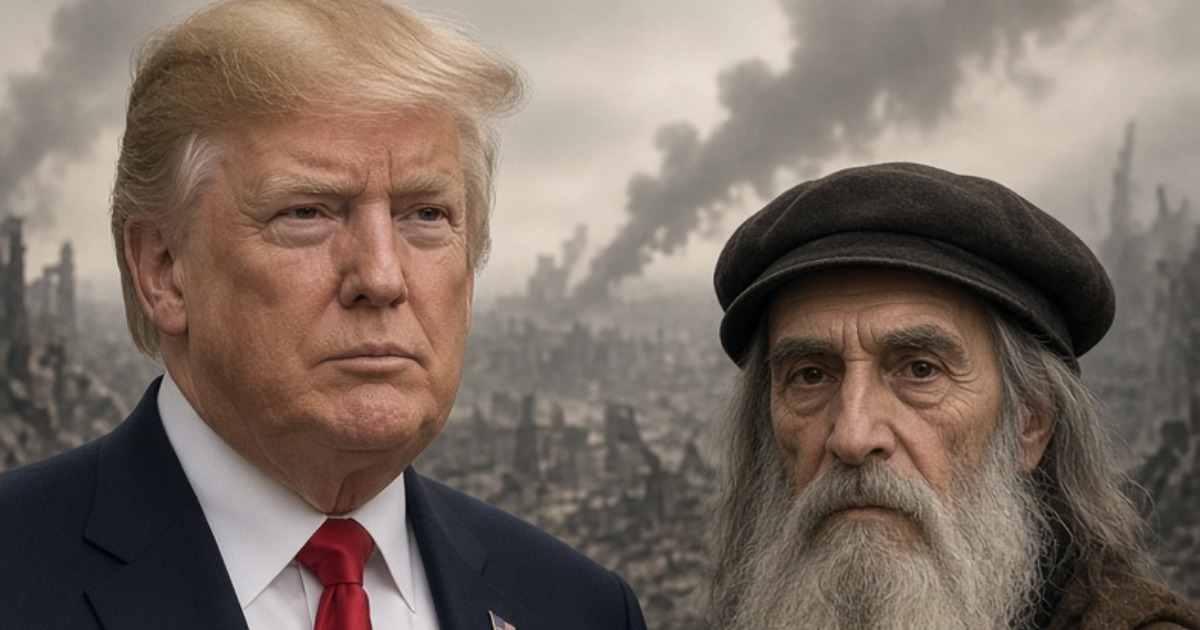
As 2027 approaches, the mysterious writings of Nostradamus have once again attracted attention, with interpreters linking five of his centuries-old verses to events that could supposedly unfold in the coming year.
The French astrologer, whose real name was Michel de Nostredame, lived during the 16th century and became famous for his collection of cryptic poems, known as quatrains.
His book, Les Prophéties, was first published in 1555 and contained hundreds of verses that some people believe foretold major historical events.
Over the centuries, enthusiasts have claimed that Nostradamus predicted everything from the Great Fire of London to the rise of powerful political leaders.
However, his writings are notoriously vague, and historians have repeatedly questioned claims that they accurately predict future events.
Importantly, Nostradamus never explicitly identified 2027 in the passages discussed below.
Instead, modern interpreters have connected particular verses to contemporary concerns, including economic instability, international politics and environmental disasters.
Here are five predictions that have been associated with the coming year.
1. A major global financial crisis
One of the most concerning interpretations involves the possibility of a major economic downturn.
A passage attributed to Nostradamus describes a society overwhelmed by debt, alongside references to gold, silver and financial documents losing their value.
The verse includes imagery of wealth being discarded and financial obligations disappearing.
Some modern interpreters believe the passage could symbolise a widespread debt crisis or a collapse in confidence in financial institutions.
They have linked the imagery to concerns about government borrowing, inflation and the stability of the global financial system.
However, the poem does not identify any modern economy, currency or financial institution.
There is also no evidence that it was written specifically about 2027.
While economic crises are possible in any year, the passage cannot reliably establish that one is approaching.
2. A surprise political upset in France
Another prediction has been linked to France's presidential election, which is scheduled to take place in 2027.
President Emmanuel Macron is approaching the end of his second consecutive term, making the upcoming election a significant event in French politics.
Some Nostradamus enthusiasts have focused on a verse from Century IX, Quatrain 27, which includes references to a forester, a bridge and a figure described as the Dauphin.
Historically, the title Dauphin was used for the heir to the French throne.
Modern interpreters have suggested that the figure could symbolise a political successor or a candidate expected to inherit power.
Under this interpretation, the passage supposedly points towards an unexpected challenge to a leading presidential contender.
However, the verse does not mention a presidential election, a modern political party or any identifiable contemporary candidate.
The connection to the 2027 election is therefore speculative rather than a historically established prediction.
3. Extreme heat and devastating wildfires
A third interpretation concerns the possibility of severe environmental disasters.
One passage attributed to Nostradamus describes fire descending from the heavens, spreading across different regions and leaving the natural world struggling to survive.
Some readers have interpreted this imagery as a warning about rising temperatures, prolonged droughts and destructive wildfires.
The interpretation has attracted attention because of the growing impact of extreme weather in several parts of the world.
Wildfires have repeatedly affected regions including California, southern Europe and parts of Australia, while scientists continue to study the relationship between climate change and fire risk.
Human-caused climate change is increasing the likelihood and intensity of certain extreme heat events, and it can worsen wildfire conditions in some regions.
However, that scientific evidence is entirely separate from Nostradamus' writings.
His poem does not identify 2027, and it cannot predict the location or timing of future fires.
4. A mysterious treasure discovery with a disturbing twist
Not all of the supposed predictions involve politics or disasters.
One interpretation suggests that a long-lost treasure could finally be discovered after centuries of mystery.
Some enthusiasts have connected a Nostradamus passage mentioning treasure beneath an oak tree in Gienne to the famous Oak Island mystery.
Oak Island, located off the coast of Nova Scotia in Canada, has been the subject of treasure-hunting expeditions for generations.
Over the years, searchers have speculated that valuable artefacts, precious metals or historical documents might be hidden beneath the island.
The mystery has also inspired television programmes and numerous theories about what might be buried there.
According to the modern interpretation, Nostradamus' verse could suggest that a significant discovery is approaching.
However, the passage also contains a disturbing reference to a man suffering a fatal injury to his eye.
Some readers have connected this imagery to the popular legend of a curse surrounding Oak Island's supposed treasure.
There is no credible evidence that the verse refers to Oak Island, and the geographical connection is particularly uncertain.
Nor is there evidence that a major treasure discovery is destined to occur in 2027.
5. A possible peace summit involving Iran and Turkey
The final prediction has been interpreted as referring to a diplomatic development in the Middle East.
A passage attributed to Nostradamus mentions Persia and Trebizond, two historical geographical names.
Persia is associated with modern-day Iran, while Trebizond refers to Trabzon, a city on Turkey's Black Sea coast.
The verse also contains references to fire, weapons and the Black Sea.
Some interpreters believe these details could point towards a future meeting involving Iranian representatives in Turkey.
They have suggested that the passage might symbolise diplomatic negotiations or an attempt to resolve an international conflict.
Given the ongoing tensions involving Iran and other countries, the interpretation has attracted renewed interest.
However, the poem does not explicitly describe a peace summit or identify any modern political leaders.
There is no evidence that Nostradamus foresaw a specific diplomatic meeting in 2027.
Did Nostradamus' predictions for 2026 come true?
Before considering the supposed predictions for 2027, it is worth examining how earlier interpretations have performed.
At the beginning of 2026, Nostradamus enthusiasts circulated claims that his writings foretold several dramatic events.
Among them were interpretations involving the assassination of a prominent figure and a devastating European conflict.
One verse described an important person being struck down, while another referenced Mars, the Roman god associated with war.
Some readers connected these passages to fears about political violence and military escalation.
However, the specific events anticipated by those interpretations had not materialised as described by early November 2026.
This illustrates one of the central problems with Nostradamus predictions: broad and ambiguous wording can be applied to many different events.
When an interpretation fails, enthusiasts may subsequently connect the same verse to another incident or time period.
Could Nostradamus really predict the future?
There is no scientifically established evidence that Nostradamus possessed the ability to foresee future events.
His quatrains frequently use symbolism, historical references, unusual imagery and language that can be interpreted in several different ways.
Many alleged predictions are identified only after the events they supposedly describe have already occurred.
This process is known as retrospective interpretation, in which people connect an ambiguous statement to a known event after the fact.
It can create the impression of remarkable accuracy without demonstrating genuine predictive ability.
Another difficulty is that Nostradamus' writings were produced in 16th-century French, with some passages incorporating other languages and historical references.
Translations can differ, further increasing the range of possible interpretations.
For a prediction to provide convincing evidence of foresight, it would need to be sufficiently specific, clearly documented before the event and consistently interpreted.
The modern claims surrounding Nostradamus generally do not meet those standards.
What should we make of the five predictions for 2027?
The five interpretations linked to 2027 cover a financial crisis, a French political surprise, extreme heat and wildfires, a mysterious treasure discovery and possible Middle Eastern diplomacy.
Some concern issues that already feature prominently in international news, while others rely on much more speculative connections.
None of the passages explicitly identifies 2027 as the year in which these events will happen.
Although Nostradamus remains a fascinating historical figure, his writings are better understood as cryptic literature that has inspired centuries of debate than as a reliable guide to the future.
For now, the supposed predictions offer an intriguing glimpse into how people continue to interpret his work, rather than proof of what the coming year has in store.
Source: UNILAD, Joe Yates, November 7, 2026. The predictions discussed are modern interpretations of writings attributed to Nostradamus and are not scientifically verified forecasts.