Newly released 911 recordings have revealed the terrifying reactions of witnesses who watched the aftermath of a private jet crash in Florida that killed nine people, including two young children.
The Learjet 60 crashed near a mobile home community in Greenacres, Palm Beach County, on November 1, 2026, after experiencing a catastrophic loss of altitude.
The aircraft had been travelling from Austin, Texas, to North Eleuthera Airport in the Bahamas when the flight ended in tragedy.
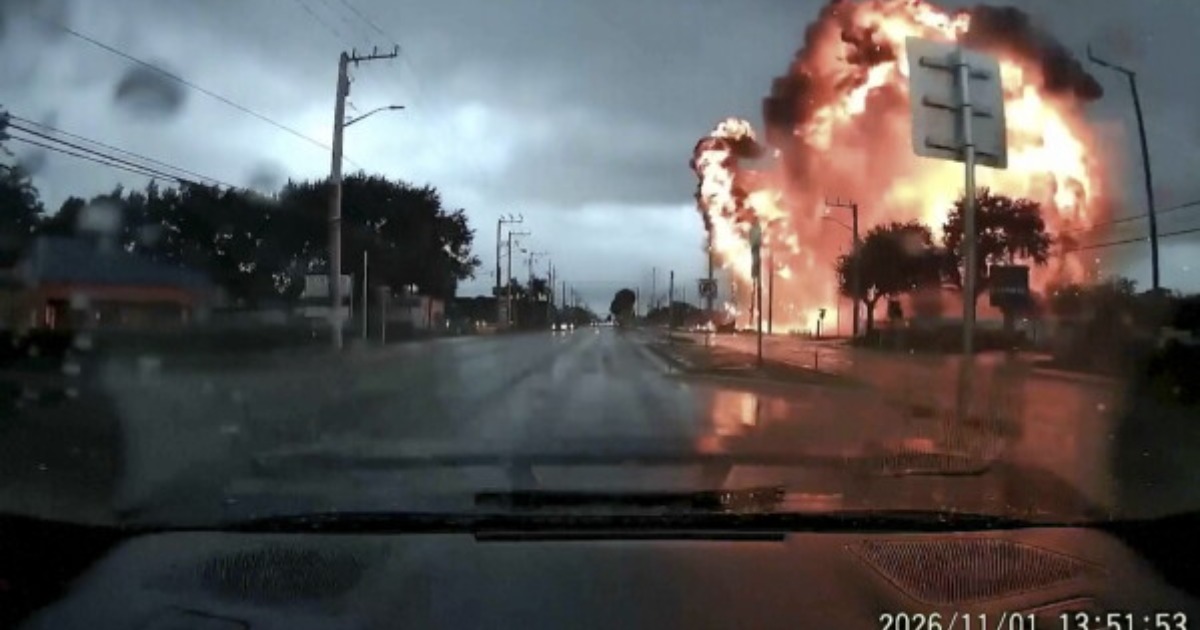
Dashcam footage captured the jet striking the ground and erupting into a massive fireball, leaving a crater at the crash site.
In the days following the disaster, investigators began examining the aircraft's final moments, while recordings of communications involving the pilots attracted widespread attention.
Now, audio from emergency calls made immediately after the crash has provided another perspective on the tragedy.
What did witnesses say in the newly released 911 audio?
The recordings capture the confusion experienced by local residents as they attempted to understand what had caused the enormous explosion.
Some witnesses were initially unable to determine whether an aircraft had crashed or whether another type of incident had occurred.
In one emergency call, a distressed resident reported hearing an explosion and suggested that an aircraft might have fallen from the sky.
The dispatcher asked whether the noise could have been caused by lightning, but the caller was unable to confirm what had happened.
The resident explained that the impact had been powerful enough to shake their home.
Another caller contacted emergency services requesting police assistance because they believed an explosive device might have landed nearby.
According to reporting cited by VT from NBC6, another witness described seeing something fall from the sky before hearing an explosion.
That caller also reported that the force of the incident had been felt inside nearby homes.
A separate witness described the explosion as extremely large and told emergency services that it had occurred near the area's mobile homes.
The calls illustrate how little information residents initially had as emergency crews began responding to the scene.
Why did some residents think the crash was a bomb or missile?
The Learjet's impact was sudden and violent, producing a large fireball that could be seen in footage captured by passing motorists.
Witnesses who had not seen the aircraft descending were confronted with an unexpected explosion and the sound of a powerful impact.
Without knowing what had caused the incident, some residents speculated that an explosive object or missile might have struck the neighbourhood.
However, authorities identified the incident as an aircraft crash.
There is no indication in the supplied reporting that a missile or bomb caused the disaster.
The initial descriptions reflected the uncertainty of witnesses contacting emergency services, rather than an official assessment of what had occurred.
Who were the nine people killed in the Learjet crash?
All nine people aboard the Learjet 60 died in the crash.
The flight crew consisted of captain Jeff Gregory, 55, and co-pilot Nathalia Gadelha Filgueiras, 20.
The passengers included Austin-based technology entrepreneur Adam Robinson, 44, and his wife, Helen Sharp.
The couple were travelling with their two children, four-year-old Emma and two-year-old Charlie.
Also aboard were the family's nanny, Anita Maria Apellido Cetina, and two friends, Rachael Reed and Charmi Fehr.
The deaths of the young children and the other passengers have added to the heartbreak surrounding the incident.
Tributes have emerged as the victims' families and friends attempt to come to terms with the tragedy.
What happened during the Learjet's final moments?
Before the crash, the aircraft had been communicating with air traffic control while travelling towards the Bahamas.
Audio published through LiveATC, a service that provides access to aviation radio communications, reportedly captured exchanges between the crew and controllers.
According to VT, Filgueiras initially reported that the aircraft was encountering turbulence and icing conditions.
She subsequently requested permission to climb to a higher altitude.
However, the situation rapidly deteriorated as the jet began descending at an extraordinary rate.
The co-pilot issued an emergency declaration, informing air traffic control that the aircraft was descending thousands of feet per minute.
She then reported that the rate of descent had increased to approximately 20,000 feet per minute and that the aircraft was experiencing an overspeed condition.
Those communications indicated that the crew was dealing with a rapidly developing emergency.
What were the pilots' final words before the crash?
According to the recording described by VT, the co-pilot's final communications became increasingly urgent as the aircraft continued losing altitude.
Filgueiras reportedly alerted captain Gregory to look outside before expressing alarm at the time remaining.
The recording then captured an air traffic controller attempting to contact the aircraft again.
No response was received from the Learjet.
The audio has attracted attention because of the speed at which an apparently manageable flight situation became a fatal emergency.
However, recordings alone cannot establish the precise technical cause of the accident.
How quickly did the Learjet fall?
Reports surrounding the incident have described an exceptionally rapid descent before the aircraft struck the ground.
VT reported that the jet was descending at a rate exceeding 22,000 feet per minute during its final moments.
That figure represents a vertical descent rate rather than the aircraft's forward speed.
The dramatic loss of altitude left the crew with very little time to respond before impact.
The aircraft ultimately crashed in Greenacres, where the resulting explosion alarmed residents and prompted numerous emergency calls.
What caused the Florida Learjet crash?
The cause of the November 1 crash remains under investigation.
Investigators have been examining evidence from the crash site, including aircraft wreckage and information about the flight's final movements.
The reported turbulence and icing conditions are among the circumstances described in the available communications, but their presence does not establish that either caused the crash.
Aviation accident investigations can involve examining aircraft systems, maintenance records, weather conditions, flight data and crew actions.
Investigators must assess the available evidence before determining what happened.
Until an official finding is released, claims assigning a definitive cause to the crash would be premature.
What happens next in the investigation?
Investigators are continuing efforts to recover and examine aircraft components from the crash site.
Evidence from the wreckage, air traffic control communications and other available records may help establish the sequence of events.
The newly released 911 recordings primarily document the experiences of witnesses on the ground rather than the technical circumstances aboard the aircraft.
Nevertheless, they provide a stark account of the moments immediately following the disaster.
For residents who witnessed the explosion, the emergency calls capture the shock of an incident that unfolded with almost no warning.
For the families of the nine victims, the recordings are another painful reminder of the tragedy that occurred on November 1.
Source: VT, Kim Novak, November 8, 2026, citing NBC6 and LiveATC. The reported audio descriptions have not been independently authenticated for this article.