A map has revealed which US states could experience comparatively lower levels of radioactive fallout in the event of a nuclear attack, as a former senior FBI official urges Americans to prepare for potential emergencies.
With international tensions continuing to fuel concerns about the possibility of a wider conflict, researchers have examined what could happen if nuclear weapons were used against American military infrastructure.
The findings highlight substantial differences in potential radiation exposure across the country, with some states facing considerably greater risks than others.
Meanwhile, former FBI Deputy Director Dan Bongino has encouraged Americans to keep essential emergency supplies at home, warning that families should not wait until a crisis to prepare.
Although the map and Bongino's warning concern different aspects of emergency preparedness, both have attracted attention amid growing discussion about national security and the possibility of major disruptions.
Which US states would be safest if World War 3 broke out?
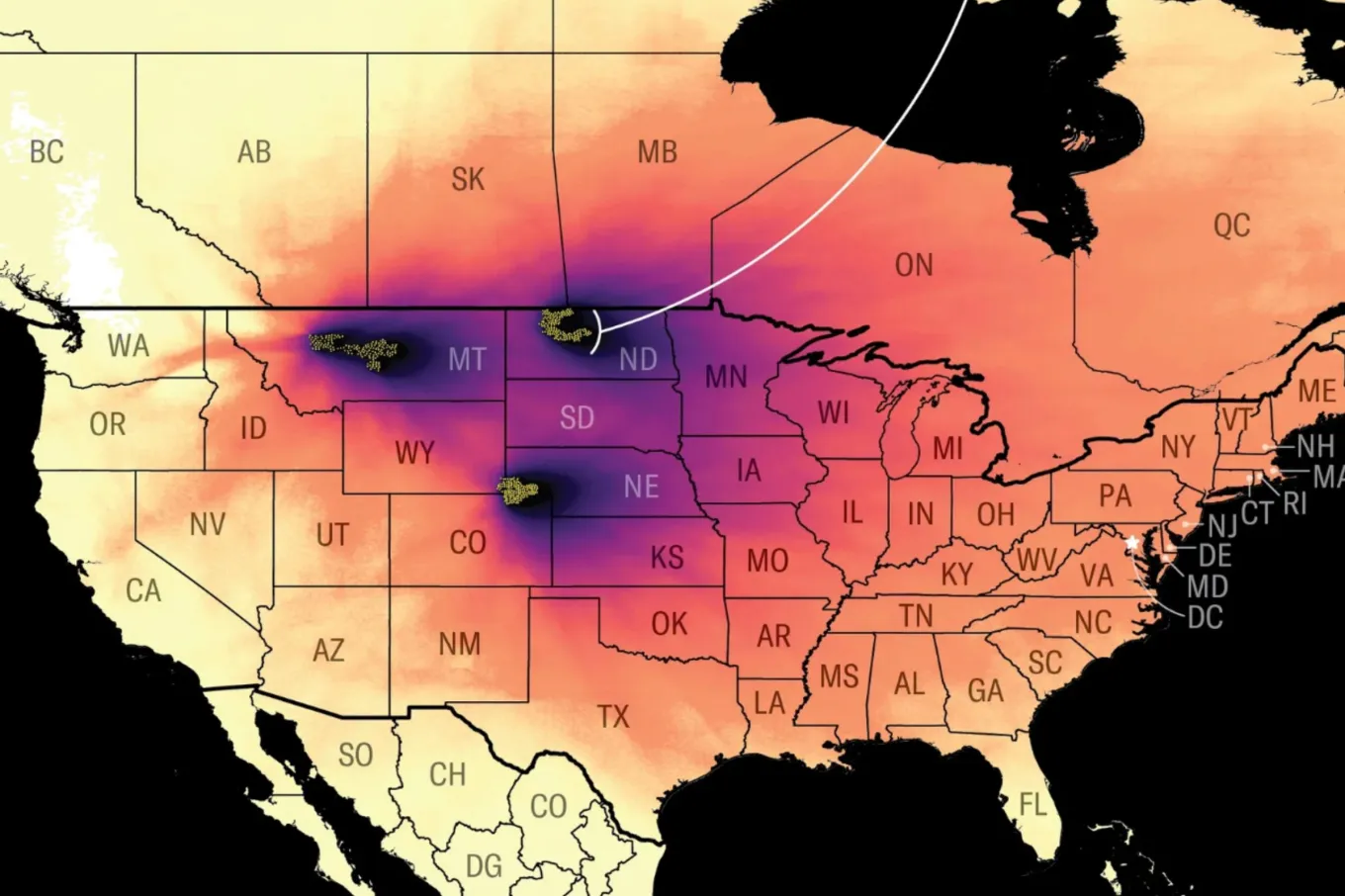
According to a nuclear fallout simulation originally published by Scientific American and subsequently examined by Newsweek, several states in the eastern and southeastern United States would experience comparatively lower radiation exposure in one particular nuclear attack scenario.
The research focused on a hypothetical attack against American intercontinental ballistic missile silos rather than every possible target in a wider world war.
In the average-case simulation, the states identified as experiencing the lowest levels of fallout were:
Washington, DC, was also included among the areas experiencing comparatively low exposure.
Other states, including Washington, Oregon, Idaho, Nevada, California, Utah, Arizona, New Mexico, Texas, Arkansas and Illinois, were projected to experience relatively lower exposure than the most heavily affected regions.
However, the results should not be interpreted as a guarantee that these locations would be safe during an actual nuclear war.
The simulation examined radioactive fallout from attacks on specific missile installations. It did not account for every potential military target, direct attacks on major cities or the wider consequences of a global nuclear conflict.
Which states would be most dangerous during a nuclear attack?
The simulation identified eight states that could face particularly severe radioactive fallout following strikes against America's land-based nuclear missile infrastructure.
They were:
Several of these states contain or are located near major missile silo fields, making them especially vulnerable in the scenario researchers examined.
According to Newsweek's analysis, estimated cumulative radiation exposure in the most affected areas ranged from approximately 1 gray to 84 grays.
A gray, abbreviated Gy, is a measurement of absorbed radiation dose.
Whole-body exposure to extremely high doses of radiation can be fatal, although the health consequences depend on factors including the dose, duration of exposure and medical treatment available.
By comparison, areas in the lowest-exposure category of the average-case simulation received estimated cumulative doses ranging from approximately 0.001 Gy to 0.5 Gy.
How was the nuclear fallout map created?
The research was developed by scientists including Sébastien Philippe, Ivan Stepanov and Svitlana Lavrenciuc.
It examined the consequences of a coordinated nuclear attack targeting US missile silos across North Dakota, Montana, Wyoming, Nebraska and Colorado.
Researchers modelled radioactive fallout using historical weather conditions from each day of 2021.
The calculations considered how radioactive material could travel through the atmosphere depending on wind direction and other meteorological factors.
The resulting maps showed estimated cumulative outdoor radiation doses over four days.
Newsweek subsequently used the findings to identify states that could experience relatively lower exposure under average and particularly severe conditions.
In one worst-case scenario, the states with comparatively lower exposure were concentrated even more heavily along the East Coast and in the Southeast.
These included Maine, New Hampshire, Vermont, Massachusetts, Rhode Island, Connecticut, New York, New Jersey, Pennsylvania, Delaware, Maryland, Virginia, West Virginia, North Carolina, South Carolina, Georgia, Florida, Alabama and Mississippi, as well as Washington, DC.
However, even these areas were projected to experience potentially significant radiation exposure in that scenario.
What warning did former FBI Deputy Director Dan Bongino issue?
Separately, former FBI Deputy Director Dan Bongino urged Americans to prepare their households for emergencies during an October 26, 2026, episode of The Dan Bongino Show.
Bongino, who previously served as a Secret Service agent, encouraged listeners to maintain enough essential supplies to manage a disruption lasting at least three days.
He argued that people should consider how they would cope if access to electricity, water or other essential services were interrupted.
His remarks followed reporting about Pentagon efforts to improve the resilience of military installations during potential infrastructure disruptions.
Bongino encouraged households to take preparedness seriously rather than assuming essential services would always remain available.
"Get your stuff today. Please. Do it for your family," he said.
His comments were general emergency preparedness advice, not an official FBI warning that a nuclear attack was imminent.
What items did Bongino tell Americans to stockpile?
Bongino recommended maintaining at least three days' worth of essential supplies, including food, water and backup power.
Among the items he specifically mentioned were:
He encouraged Americans to think about the needs of their families before an emergency occurred.
Bongino also referenced preparedness guidance issued by European governments, where households have increasingly been encouraged to maintain emergency supplies.
While he discussed the possibility of serious infrastructure disruptions, his advice was not limited to nuclear war.
Emergency supplies can also be useful during severe storms, flooding, prolonged electricity outages and other disasters.
What does the US government recommend keeping at home?
The Federal Emergency Management Agency (FEMA) advises Americans to prepare emergency supply kits containing essentials that can support a household during a disaster.
Official recommendations include storing at least one gallon of water per person per day for several days, along with non-perishable food.
FEMA also recommends a battery-powered or hand-crank radio, flashlight, spare batteries, first-aid kit and necessary medications.
Additional items may include important documents, sanitation supplies, a manual can opener and provisions for children or pets.
For a radiological emergency, the federal government's Ready.gov guidance advises people to get inside a substantial building, remain indoors and follow official instructions.
Being inside a basement or central area of a building, away from exterior walls and windows, can reduce exposure to radioactive fallout.
Officials also advise avoiding potentially contaminated food and water and relying on protected supplies where possible.
Would anywhere in America actually be safe during nuclear war?
Despite the findings of the simulation, experts have warned that no US state could be considered completely safe in a major nuclear conflict.
John Erath, senior policy director at the Center for Arms Control and Non-Proliferation, told Newsweek that people living near military facilities and missile installations could face particularly severe immediate consequences.
However, he stressed that the wider effects would extend beyond areas directly targeted.
Those consequences could include radioactive contamination, disruption to food and water supplies, damaged infrastructure and prolonged economic instability.
Researchers have also warned that a sufficiently large nuclear exchange could affect global temperatures and agricultural production.
Such effects could create serious food shortages even in countries that were not directly attacked.
The simulation therefore illustrates differences in fallout exposure under a defined set of assumptions, rather than providing a definitive ranking of where people should live to survive World War 3.
Why are nuclear war concerns growing in 2026?
International security concerns have intensified during 2026 amid conflicts involving major powers and renewed debate about nuclear deterrence.
In January, the Bulletin of the Atomic Scientists moved its symbolic Doomsday Clock to 85 seconds before midnight, its closest setting to catastrophe.
The organisation cited a combination of nuclear risks, geopolitical tensions and other global threats.
The expiration of the New START nuclear arms control treaty between the United States and Russia in February also raised concerns about the future of limits on strategic nuclear arsenals.
However, the Doomsday Clock is a symbolic assessment of global dangers rather than a prediction that nuclear war will occur at a particular time.
Similarly, the fallout simulation does not indicate that a nuclear attack against the United States is planned or imminent.
What should Americans take away from the map and warning?
The findings suggest that geography could play an important role in determining radioactive fallout exposure during a nuclear attack on American missile silos.
States farther from the targeted installations were generally projected to experience lower exposure in the model, although prevailing winds and other factors could substantially change the results.
Meanwhile, Bongino's advice reflects a broader recommendation from emergency management authorities that households should maintain essential supplies and understand how to respond to disruptions.
Neither the map nor his comments establish that World War 3 is imminent.
For Americans concerned about emergency preparedness, official guidance from FEMA and Ready.gov remains a practical starting point.
Sources: Newsweek, December 4, 2024, updated May 18, 2026; Scientific American, Under the Nuclear Cloud; The Dan Bongino Show, October 26, 2026; UNILAD, October 27, 2026; FEMA; Ready.gov; Center for Arms Control and Non-Proliferation.