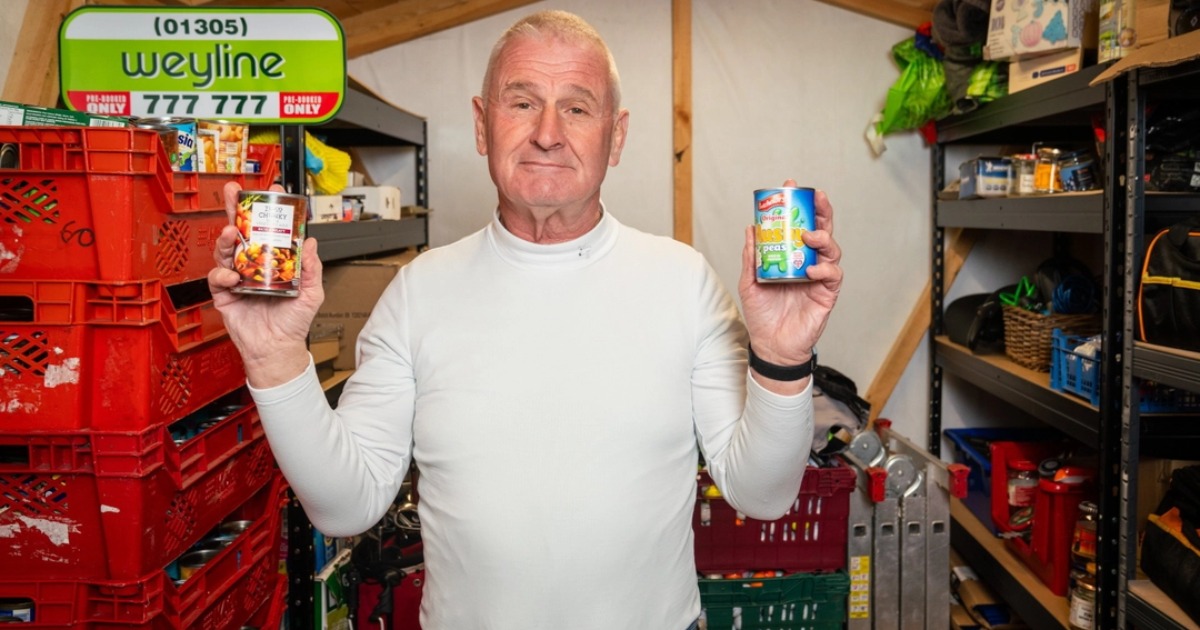
A 71-year-old man who has spent nearly $1,300 preparing for a potential 100-day lockdown has revealed what he believes could become worthless if a major emergency disrupted everyday life.
Ian Ferguson, from Weymouth in Dorset, began stockpiling food and survival equipment after Russia invaded Ukraine in February 2022.
Four years later, he has accumulated approximately 600 cans of food alongside an extensive collection of emergency supplies.
But despite his preparations, Ian believes many people are overlooking something fundamental about how society would function if a major crisis interrupted essential services.
He has also warned that people could find themselves relying on resources that suddenly become much less useful than they expect.
Why has Ian Ferguson been stockpiling food?
Ian started preparing for a potential emergency in 2022, following Russia's full-scale invasion of Ukraine.
The conflict prompted concerns about international security, energy supplies and the possibility of wider disruption.
Rather than waiting for an emergency to happen, Ian decided to gradually build up enough supplies to survive independently for an extended period.
He now owns approximately 600 cans of food, including soups, stews, beans, curries, rice pudding and fruit.
According to Ian, consuming six cans each day would provide enough food to last him approximately 100 days.
He believes having a substantial food supply is a sensible precaution against circumstances that could prevent people from accessing supermarkets.
The 71-year-old has compared emergency food storage to taking out insurance against an unexpected event.
His concern is that many households have relatively little food available if their normal shopping routines are interrupted.
What does he believe will become worthless in an emergency?
Ian believes that money could become effectively worthless if a serious emergency caused supermarkets to run out of food and essential supplies.
His argument is that having money would provide little practical benefit if there was nothing available to purchase.
He fears that a prolonged disruption could leave people unable to obtain basic necessities, regardless of how much they have in their bank accounts.
In particular, Ian is concerned about the increasing dependence on digital systems for payments, stock management and deliveries.
He believes a major failure affecting these systems could bring everyday commercial activity to a halt.
However, Ian makes an important distinction between money losing its purchasing power during extreme shortages and the usefulness of physical cash during shorter disruptions.
He actually supports keeping banknotes and coins available, arguing that they could remain useful when electronic payment systems stop functioning.
Why is he worried about digital payments?
Ian, who owns a taxi company, has expressed concern about the growing reliance on technology throughout modern supply chains.
He pointed to cyberattacks affecting supermarkets and water companies as examples of how disruption can affect essential services.
In his view, a sufficiently serious technological failure could interfere with deliveries, inventory systems and the ability of businesses to process transactions.
He believes that society has become increasingly dependent on systems that many people take for granted.
Ian also warned that relying entirely on mobile phones or electronic payments could create problems if devices lose power or payment terminals stop working.
For that reason, he advocates retaining access to physical cash as a practical backup.
Although digital infrastructure can experience outages, this does not mean that a widespread failure or prolonged collapse is inevitable.
What supplies has Ian collected for a 100-day lockdown?
Alongside his substantial collection of canned food, Ian has purchased equipment intended to help him manage without normal household services.
His emergency supplies include:
Ian believes having access to food, water and essential equipment could make a significant difference if households were forced to remain at home for an extended period.
His preparations are based on the possibility of a prolonged disruption rather than any confirmed announcement of a future lockdown.
Does he worry about the expiry dates on his canned food?
Despite having collected hundreds of cans over several years, Ian says he is not particularly concerned about the dates printed on the packaging.
He believes consumers sometimes place too much emphasis on food labelling and argues that manufacturers benefit when people frequently replace products.
However, food safety guidance distinguishes between use-by dates, which relate to safety, and best-before dates, which generally concern quality.
Food past its use-by date should not be consumed, while some unopened canned foods may remain suitable beyond their best-before date if they have been stored correctly and their packaging remains intact.
Cans that are swollen, leaking, severely damaged or showing other signs of spoilage should not be eaten.
Anyone building an emergency food supply should regularly check and rotate their stock rather than assuming that all canned products remain safe indefinitely.
What does Ian believe is missing from his survival supplies?
Although Ian has spent years preparing, he acknowledges that there are some resources he has not purchased.
One is a solar power system.
He believes households with solar panels and suitable supporting equipment could potentially have an advantage during certain electricity disruptions.
Solar panels alone do not necessarily provide power during an outage, however, as many grid-connected systems automatically shut down unless they have appropriate backup capabilities.
Ian says he does not intend to invest in solar panels at his age, but hopes communities would support one another during a serious emergency.
He has stressed that his preparations are not simply about protecting himself while others struggle.
Instead, he hopes people would demonstrate kindness and cooperation if a crisis occurred.
Should other households prepare for an emergency?
Emergency preparedness does not necessarily require spending thousands of dollars or storing enough food for several months.
Government emergency planning guidance generally encourages households to consider how they would manage during temporary disruptions to electricity, water, communications or access to shops.
Practical preparations can include keeping drinking water, non-perishable food, necessary medication, a torch, batteries and a way to receive emergency information.
Maintaining a modest supply of physical cash may also be useful during payment-system outages, although it is not a substitute for access to essential goods.
For Ian, the important lesson is to consider what might happen if services people rely on suddenly became unavailable.
While his predictions about a prolonged breakdown of supply chains remain hypothetical, his preparations reflect a wider interest in household resilience.
And after four years of collecting supplies, he has no immediate plans to stop.
Source: UNILAD, November 11, 2026, reporting an interview with Ian Ferguson supplied by SWNS.