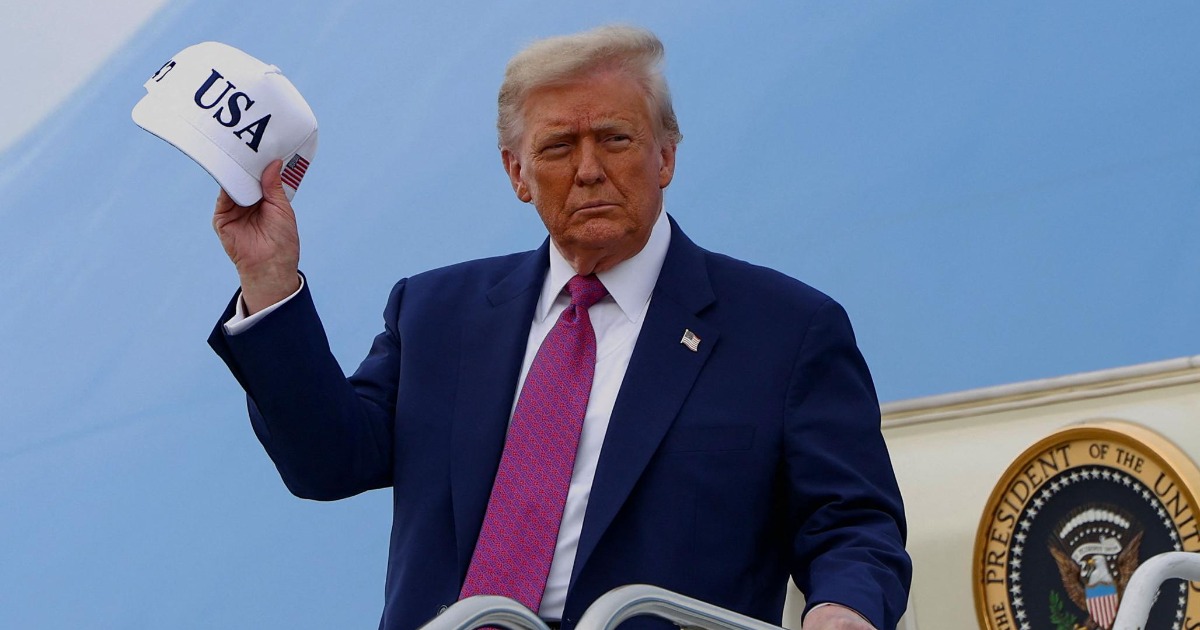
Donald Trump's latest comments surrounding the 2026 midterm elections have raised fresh questions about his proposed $5,000 payments to Americans, after the president previously linked the money to Republicans retaining control of Congress.
Millions of people had been watching the proposal since Trump announced it in September, suggesting that adult US citizens could receive a substantial government payment following the November elections.
However, the results have dramatically changed the political landscape in Washington, with Democrats winning control of both the House of Representatives and the Senate.
Now, Trump has shared social media posts questioning aspects of the election results, prompting renewed interest in what the developments could mean for the proposed payments.
Here's what has happened, what the president has said and where the $5,000 checks currently stand.
Could Trump's midterm claims change the outcome of the $5,000 checks?
Trump's latest claims do not automatically change the election results or revive the proposed $5,000 payments.
The president originally made the payments conditional on Republicans retaining control of both chambers of Congress in the November 3 midterms.
However, Democrats secured control of the House and Senate, meaning that condition has not been met.
Even if Trump continues questioning the results, social media posts alone cannot overturn certified election outcomes or change which party controls Congress.
Any formal challenge would need to follow the relevant legal procedures and be supported by evidence.
There is currently no verified evidence in the posts described by news reports that establishes widespread election fraud or would justify changing the results.
That means Trump's original election-dependent promise faces a significant obstacle.
However, the president could still propose a different payment programme or seek bipartisan support for legislation authorising the checks.
There is no guarantee that such legislation would pass.
What did Donald Trump say about the $5,000 checks?
Trump first announced the proposal at the Republican Party's midterm convention in Dallas on September 9, 2026.
Addressing supporters, he promised a $5,000 payment to adult American citizens if Republicans retained control of Congress.
"I will issue a dividend to every adult citizen in the United States of America for $5,000," he told the gathering.
The president presented the payment as a way of sharing what he described as the country's economic success.
He also suggested that tariff revenue could help fund the proposal, although independent analyses questioned whether the available revenue could cover the cost.
Speaking to Fox News later that month, Trump defended waiting until after the elections to deliver the payments.
He argued that Democrats would not support the initiative, saying: "Because the Democrats can't do it."
His proposal attracted attention because a payment of $5,000 per adult could cost the federal government more than $1.2 trillion.
What 'unusual patterns' did Trump highlight after the midterms?
Following the November elections, Trump shared several Truth Social posts questioning the vote totals and patterns seen in Democratic victories.
According to reporting published on November 7 and 8, the posts included charts comparing Democratic and Republican voting figures.
One widely circulated graphic suggested that Democratic votes had increased by approximately 20 million compared with the 2022 midterm elections.
The accompanying claim stated: "Republican votes stayed the same. Democrats materialized 20 million new votes."
Another post questioned sharp increases in Democratic vote totals as ballots were reported during election night.
However, election officials frequently release results in batches, which can produce sudden increases on cumulative vote-counting graphs.
Higher turnout, changes in voter preferences and differences in the timing of reported results can also explain variations between elections.
The material shared by Trump did not establish that votes had been improperly counted.
His activity attracted particular attention because he had previously told The New York Times that he was "absolutely willing" to accept the midterm results.
Why were the $5,000 payments tied to the election?
Trump made the payments a central part of his economic pitch ahead of the midterms.
He argued that Republicans retaining control of Congress would allow his administration to deliver the proposed dividend to Americans.
The idea was presented as a one-time payment rather than a permanent government benefit.
However, the administration had not announced a detailed implementation programme, eligibility application system or payment schedule.
It was also unclear how the government would finance payments on such a large scale.
Analysts estimated that distributing $5,000 to every adult American citizen would require more than $1 trillion in federal spending.
That made the proposal considerably larger than many previous government rebate programmes.
Would Congress need to approve the $5,000 checks?
House Speaker Mike Johnson said in September that Congress would need to approve legislation authorising the payments.
His comments came after Trump suggested that congressional approval might not be necessary.
Under the US Constitution, federal spending generally requires legal authorisation, and the president cannot simply create a programme involving more than $1 trillion in new payments without the appropriate authority.
That means any attempt to deliver the proposed dividend would face legislative and funding questions.
With Democrats set to control both chambers from January 2027, the administration would need to negotiate with opposition lawmakers or identify another legally authorised route.
The election result therefore affects the political prospects of the proposal, even though it does not legally prevent Congress from considering future payment legislation.
Are the $5,000 checks the same as the DOGE dividend?
No. The September 2026 proposal was separate from an earlier idea involving the Department of Government Efficiency, commonly known as DOGE.
In 2025, a proposal was floated to distribute some of the savings from federal government spending reductions to taxpayers.
Under that earlier concept, eligible households could potentially have received around $5,000 if sufficiently large savings were achieved.
However, the proposed DOGE dividend was never implemented, and no such payments were issued.
Trump also previously discussed possible payments funded by tariff revenue.
These separate proposals have sometimes caused confusion because they involve similar amounts of money but different funding mechanisms and eligibility ideas.
The $5,000 dividend announced in September 2026 was specifically tied to the outcome of the midterm elections.
When could Americans receive the $5,000 checks?
As of November 8, 2026, there is no confirmed payment date for the proposed $5,000 dividend.
No nationwide payment programme has been authorised, and there is no official application process for Americans to claim the money.
The proposal would need further political and legislative action before payments could be distributed.
Americans should therefore be cautious about websites, messages or social media posts claiming that the money is already available or that a fee must be paid to secure it.
Government payments do not require people to pay an advance processing fee to receive benefits for which they are legally eligible.
What happens next for Trump's $5,000 payment proposal?
The next major development will be the formation of the new Congress in January 2027.
Democratic control of both chambers will affect the administration's ability to advance its legislative priorities, including any attempt to authorise the proposed dividend.
Trump could still ask Congress to consider a payment programme, but it would need to address the substantial cost and secure the necessary legislative support.
Meanwhile, his social media posts questioning the election results do not independently change the outcome of the midterms.
For Americans hoping to receive $5,000, the central distinction is between a political promise and an approved government payment.
At present, the proposed checks remain a promise rather than an authorised benefit, and no official distribution timetable has been announced.
Sources: Reuters, September 9 and November 5, 2026; Associated Press, September 13, 2026; Axios, September 10 and 13, 2026; PolitiFact, September 10 and October 7, 2026; Democracy Docket, November 7, 2026.