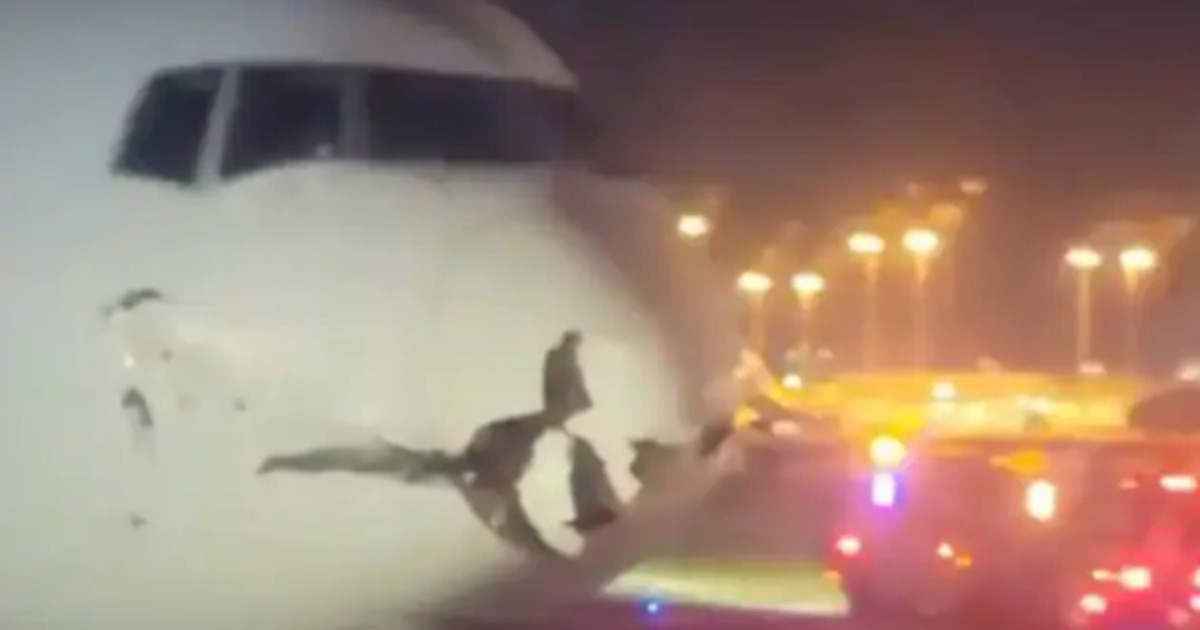
A chilling new 3D animation has reconstructed the final moments of a private jet that crashed in South Florida, killing all nine people on board.
The Learjet 60 was travelling from Austin, Texas, to the Bahamas on Sunday, November 1, 2026, when it crashed in Palm Beach County, Florida.
Among those killed were 20-year-old co-pilot Nathalia Gadelha Filgueiras and 55-year-old captain Jeff Gregory, alongside seven passengers, including two young children.
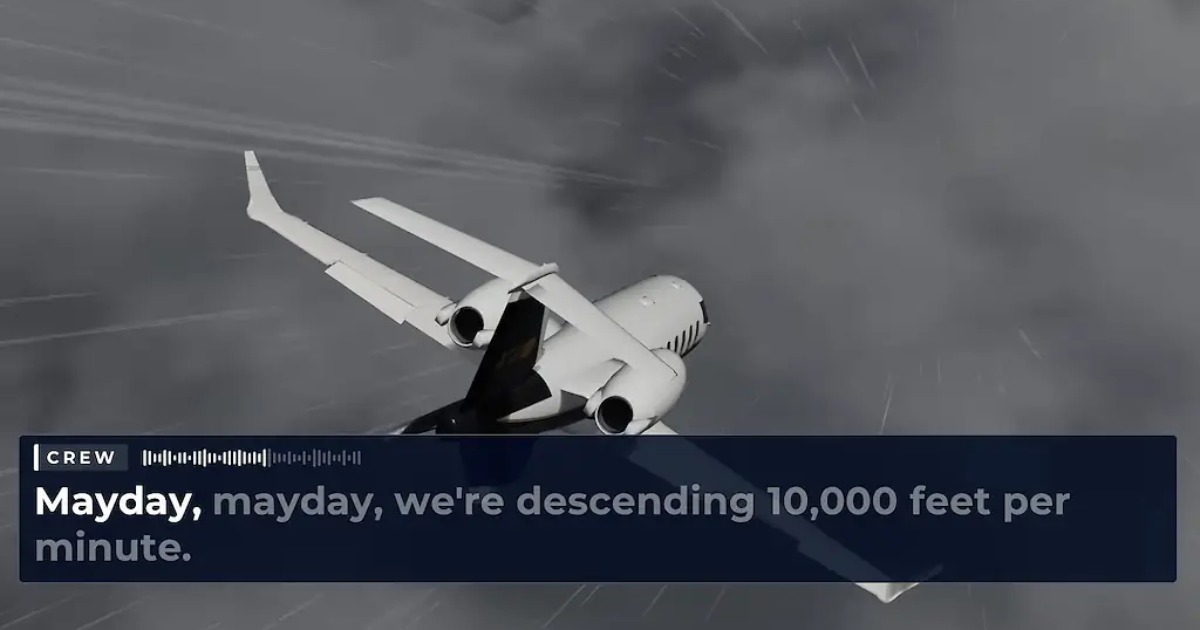
Now, a reconstruction published on YouTube has combined air traffic control recordings, flight-tracking information and weather radar data to illustrate how the emergency unfolded.
The animation focuses on a critical 68-second period during which the aircraft experienced a dramatic loss of altitude.
Although investigators have not yet determined the cause of the crash, the reconstruction offers a closer look at the aircraft's final recorded movements and the desperate communications from its crew.
What does the 3D animation show?
The animation, uploaded by the YouTube channel AP Way, uses air traffic control recordings, ADS-B flight-tracking data and weather radar information to recreate the Learjet's final moments.
It begins with the aircraft flying at approximately 35,000 feet as its crew communicates with air traffic controllers about weather conditions ahead.
The crew had requested a higher altitude, and the aircraft continued climbing before reaching its highest recorded point.
According to the reconstruction, the Learjet reached approximately 35,450 feet before beginning a rapid and increasingly severe descent.
Within seconds, its vertical speed began increasing dramatically.
The animation shows how the aircraft's flight path changed as it lost altitude, while accompanying audio reveals the crew's attempts to communicate the developing emergency.
By the end of the 68-second sequence, the aircraft's final transmitted altitude had fallen to approximately 8,750 feet.
The reconstruction is based on available flight data rather than footage recorded inside the aircraft, and it should not be treated as an official determination of the crash's cause.
What happened during the Learjet's final 68 seconds?
The animation provides a second-by-second account of the aircraft's rapidly deteriorating flight conditions.
After reaching approximately 35,450 feet, the jet began descending.
According to the video's narration, just six seconds later, the aircraft was losing altitude at a rate exceeding 3,000 feet per minute.
Ten seconds after that, its descent rate had reportedly increased to approximately 14,000 feet per minute.
The aircraft's speed continued increasing as it descended.
Rather than maintaining a straight flight path, the jet began turning to the right.
The reconstruction depicts that turn becoming progressively tighter as the aircraft followed a spiralling path towards the ground.
Its ground speed reportedly exceeded 500 knots, equivalent to approximately 575 miles per hour.
As the emergency developed, the co-pilot repeatedly communicated with air traffic controllers about the aircraft's rapid descent.
The animation concludes its 68-second sequence at the last recorded altitude transmitted by the aircraft's transponder.
The crash itself occurred after that final recorded point.
What did the co-pilot say during the emergency?
Air traffic control recordings captured the crew's urgent communications as the Learjet experienced a severe loss of altitude.
Co-pilot Nathalia Gadelha Filgueiras, 20, reported that the aircraft was descending at an increasingly dangerous rate.
In one transmission, she declared an emergency while reporting descent rates of thousands of feet per minute.
She subsequently warned controllers that the aircraft was in an overspeed condition and descending at approximately 20,000 feet per minute.
As the situation worsened, Filgueiras reported that the aircraft was descending at approximately 22,000 feet per minute and banking at an angle of 60 degrees.
The recordings also captured her warning that the aircraft was heading towards the ground.
Air traffic control personnel continued responding to the crew during the emergency, asking what assistance was required.
The transmissions provide an insight into the seriousness of the situation, although they do not establish what initially caused the aircraft to lose control.
Why was the Learjet descending so quickly?
The animation describes how the aircraft's increasing speed and steep descent created an extremely dangerous flight condition.
Its narrator explains that high-altitude flight presents particular challenges because the margin between an aircraft's minimum safe speed and maximum permitted speed can become narrower.
As the Learjet descended, its speed increased substantially.
The reconstruction suggests that the aircraft entered a spiralling descent while experiencing an overspeed condition.
Overspeed occurs when an aircraft exceeds a relevant operating speed limit, potentially placing additional aerodynamic loads on its structure and control surfaces.
However, the animation does not prove that overspeed caused the initial emergency.
It also cannot establish whether the aircraft's unusual flight path resulted from a structural problem, a loss of control or another factor.
Those questions remain part of the National Transportation Safety Board's investigation.
What have investigators discovered about the aircraft?
The National Transportation Safety Board (NTSB) has been examining the wreckage and available flight information to determine what caused the crash.
According to information reported by VT, investigators recovered much of the Learjet's left elevator in three separate pieces.
Those pieces were discovered at locations extending up to approximately 3.8 miles from the main crash site.
An elevator is a movable control surface on an aircraft's horizontal tail that helps control its pitch, or the movement of its nose up and down.
The discovery of separated components is an important part of the investigation, but it does not by itself establish when or why those components separated.
Investigators will need to examine the wreckage, maintenance records, flight information and other available evidence before reaching conclusions.
The NTSB has not announced a definitive cause of the crash.
Were weather conditions involved?
Weather conditions are among the factors being examined following the disaster.
Before the emergency, the flight crew communicated with air traffic control about conditions along their route.
Reports indicated that the aircraft was operating at approximately 35,000 feet, where extremely low temperatures and turbulence can present operational challenges.
The crew had requested a climb to a higher altitude.
The animation incorporates weather radar information to provide context for the aircraft's flight path.
However, the presence of adverse weather does not necessarily mean it caused the accident.
The NTSB has not established whether turbulence, icing or any other weather-related factor contributed to the emergency.
Who were the nine victims of the Florida Learjet crash?
All nine people on board the aircraft died in the November 1 disaster.
The flight was operated by captain Jeff Gregory, 55, and co-pilot Nathalia Gadelha Filgueiras, 20.
The passengers included entrepreneur Adam Robinson, 44, his wife Helen Sharp, and their two young children, Emma, four, and Charlie, two.
Also travelling with the family were their nanny, Anita Maria Apellido Cetina, and two close friends, Rachael Reed and Charmi Fehr.
The aircraft had been travelling from Texas towards the Bahamas when the emergency occurred over South Florida.
The crash also affected residents on the ground, with emergency services responding to the impact and resulting fire.
What has the co-pilot's family said?
Following the tragedy, Filgueiras' father, Allan Filgueiras, spoke publicly about his daughter's passion for aviation.
During an emotional press conference, he described their close relationship and reflected on the time they had spent flying together.
He also revealed that he had repeatedly listened to recordings of her final radio communications.
Despite the distressing circumstances, he praised the composure she demonstrated while communicating with air traffic control.
Allan described his daughter as his soulmate and spoke about the pride he felt in her achievements as a young pilot.
Her death at just 20 years old has prompted an outpouring of sympathy for her family and the loved ones of everyone killed.
Has the cause of the crash been confirmed?
As of November 8, the NTSB has not determined what caused the Learjet 60 to crash.
The 3D animation provides a reconstruction of the aircraft's recorded movements, but it cannot establish every event that occurred inside or outside the jet.
Its depiction of the aircraft's attitude and flight path is an interpretation of available information, rather than direct visual evidence of the final moments.
Investigators are continuing to examine the aircraft's wreckage and the circumstances surrounding the emergency.
The discovery of separated tail components, the reported overspeed condition and the rapid loss of altitude are all significant details, but their relationship to the initial cause remains unresolved.
For now, the animation illustrates just how rapidly the situation developed, while the victims' families continue to await answers about what caused the tragedy.
Sources: VT, November 7, 2026; AP Way's Learjet 60 reconstruction; National Transportation Safety Board investigation information; reported air traffic control recordings.