
Governments around the world are encouraging households to prepare for emergencies, with a new map highlighting how widespread official preparedness advice has become.
From North America to Europe and Asia, countries have been promoting the importance of keeping essential supplies at home in case normal services become unavailable.
The renewed attention follows comments from former FBI Deputy Director Dan Bongino, who recently urged American families to take emergency planning seriously.
His remarks come amid growing discussions about international security, infrastructure resilience and the ability of ordinary households to cope during unexpected disruptions.
However, the advice varies between countries and does not mean that governments are predicting an imminent war or disaster.
Which countries are urging people to stockpile emergency supplies?
According to a map published by UNILAD on October 30, 2026, countries across North America, Europe, Asia, Oceania, Africa and South America have issued or promoted some form of household emergency preparedness advice.
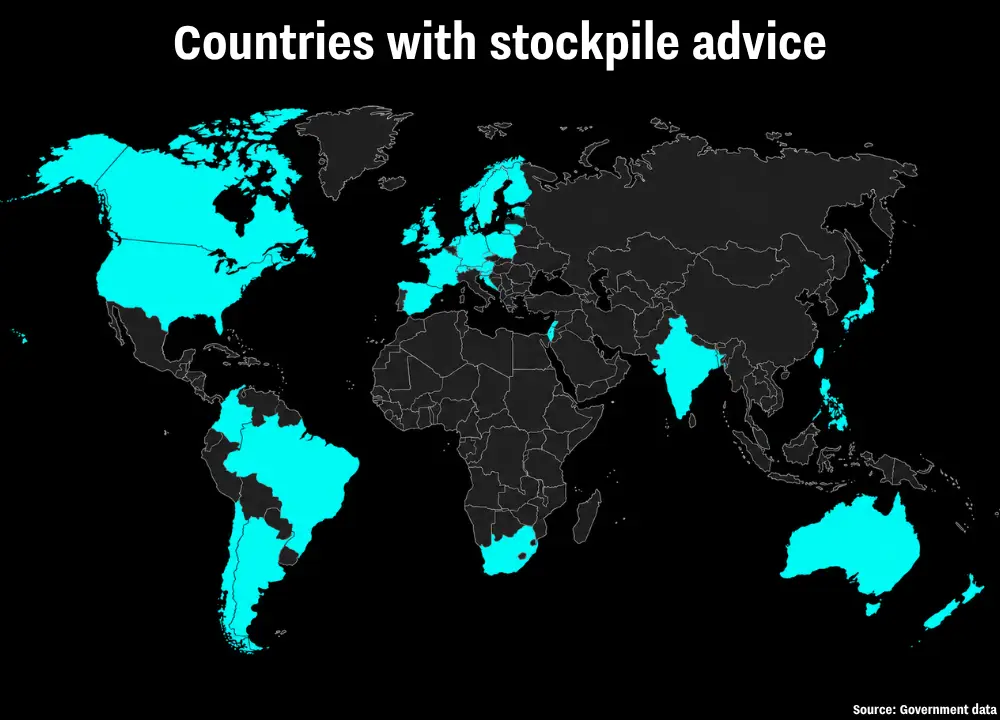
The countries identified in the report include:
North America
Europe
Asia and the Middle East
Oceania
Africa
South America
In total, the report identifies 35 countries where residents have been encouraged to consider emergency preparations.
However, the recommendations are not identical in every country, and the map should not be interpreted as evidence of one coordinated international warning.
What warning did former FBI Deputy Director Dan Bongino issue?
Bongino urged Americans to obtain emergency supplies before they might be needed, warning that families could face serious difficulties if essential services suddenly became unavailable.
Speaking on his podcast, he said: "Get your stuff today. Please. Do it for your family."
He argued that people might never need to use their emergency equipment, but that the consequences of being unprepared during a genuine crisis could be much more serious.
Bongino specifically raised concerns about families being unable to access basic necessities during an emergency.
He also suggested that people should not assume neighbours would have sufficient spare supplies to help everyone during a widespread disruption.
His remarks were presented as advice about preparedness rather than evidence that a particular emergency was about to occur.
What supplies are households being encouraged to keep?
Although individual recommendations vary, emergency preparedness guidance commonly focuses on maintaining access to basic necessities during interruptions to electricity, water, communications or transport.
Frequently recommended items include:
Bongino particularly emphasised the importance of having reliable emergency communications equipment, including a radio capable of receiving NOAA weather broadcasts in the United States.
Such radios can provide weather alerts and other important information when internet or mobile phone services are disrupted.
However, household requirements will depend on local risks, family circumstances and the recommendations issued by the relevant authorities.
What has Japan told residents to prepare?
Japan is among the countries highlighted in the report, with officials encouraging residents to maintain sufficient supplies to manage during a natural disaster.
According to reporting cited by UNILAD, Disaster Management Minister Goshi Hosono recommended that households keep at least three days of essential supplies, with a week's worth preferable where possible.
The advice includes ensuring access to food, drinking water and sanitation supplies.
Japan faces significant risks from earthquakes, tsunamis and severe weather, making household disaster preparedness an established part of public safety planning.
The recommendation should therefore not be interpreted as confirmation of a newly identified or imminent disaster.
Why are European countries encouraging emergency preparedness?
European governments have increasingly discussed the importance of civil resilience, including the ability of households to manage during temporary disruptions.
Potential scenarios include prolonged power outages, flooding, severe storms, cyberattacks and disruptions affecting essential services.
Several countries have published household preparedness guidance encouraging residents to maintain supplies and establish emergency plans.
According to UNILAD, the UK has also been highlighted in discussions about whether British households are sufficiently prepared compared with some European neighbours.
However, official recommendations vary significantly, and some countries have maintained preparedness programmes for many years.
What has Vladimir Putin said about war with Europe?
The report also draws attention to comments attributed to Russian President Vladimir Putin concerning the possibility of a wider conflict involving Europe.
Putin stated that Russia was prepared for war with Europe while maintaining that it did not want such a confrontation.
He also warned that a major escalation could have severe consequences for all parties involved.
These remarks have attracted attention amid continuing tensions between Russia and Western governments.
However, Putin's statements and the existence of household preparedness guidance do not establish that a wider European war is imminent.
Emergency planning is intended to address a broad range of risks, many of which are unrelated to armed conflict.
Does the map mean a global emergency is approaching?
No specific global emergency has been established by the map or the preparedness recommendations described in the report.
Governments routinely advise households to prepare for emergencies because natural disasters, infrastructure failures and other unexpected events can temporarily interrupt essential services.
Some countries focus heavily on earthquakes and extreme weather, while others also include national security and civil defence scenarios in their guidance.
The fact that numerous governments recommend maintaining emergency supplies does not necessarily indicate that they have received information about an impending crisis.
For households, the practical message is to understand local risks, follow official guidance and maintain reasonable supplies without panic-buying.
Source: UNILAD, Niamh Shackleton, October 30, 2026, citing Newsweek, comments from Dan Bongino, Japanese disaster preparedness guidance and reporting on statements by Vladimir Putin.