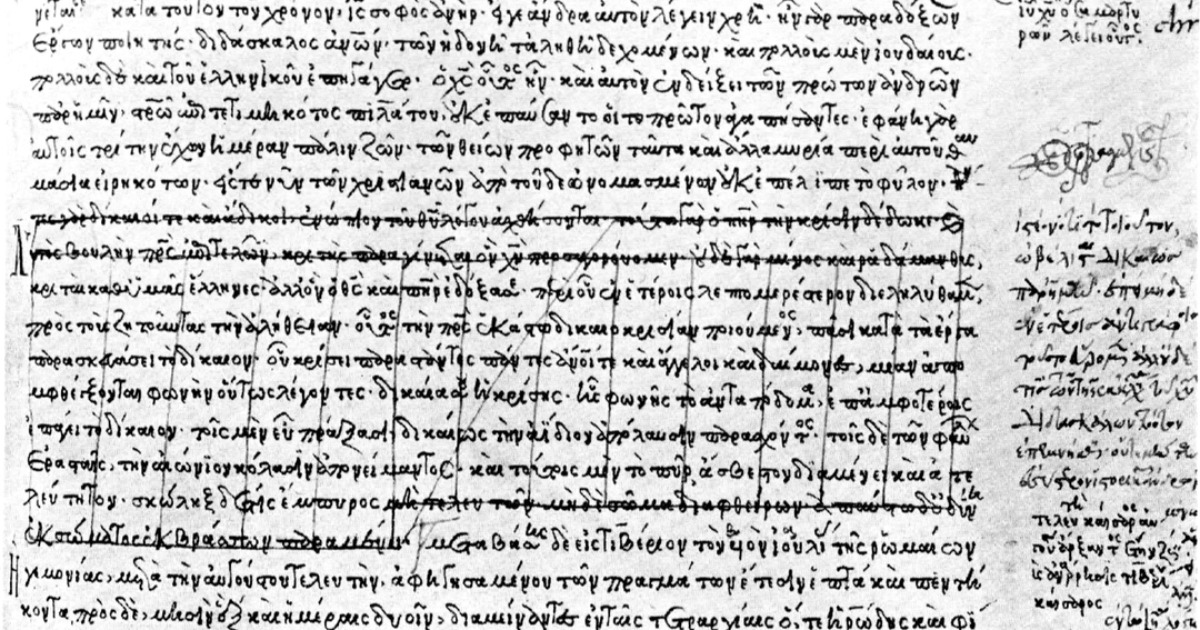

An artificial intelligence chatbot has produced a translation of an ancient historical passage that appears to describe Jesus Christ returning to life after his crucifixion.
The text, attributed to a Jewish historian writing almost 2,000 years ago, has fascinated religious scholars and historians for centuries.
It comes from a historical work written during the Roman Empire, decades after the events described in the New Testament.
Unlike the Christian Gospels, the account appears in a broader history of the Jewish people, making its references to Jesus particularly significant.
Now, Elon Musk's AI chatbot Grok has brought renewed attention to the passage by producing a modern English translation.
However, there is a major historical controversy surrounding the surviving text, with scholars disagreeing about whether all its wording can be attributed to the original author.
What does the ancient text actually say about Jesus?
The passage describes Jesus as a wise man who performed extraordinary deeds, attracted followers and was crucified under the Roman governor Pontius Pilate.
Most strikingly, the surviving version also claims that Jesus appeared alive to his followers on the third day after his death.
In the translation attributed to Grok, the passage begins:
"About this time lived Jesus, a wise man, if one ought to call him a man. He did surprising deeds, taught those accepting truth gladly, and won many Jews and Greeks."
It continues by identifying Jesus as the Christ and describing his execution under Pontius Pilate.
Then comes the section that has attracted particular attention.
"He appeared to them alive on the third day, as divine prophets foretold these and myriad wonders about him."
The passage concludes by noting that the community of Christians named after Jesus continued to exist at the time of writing.
For Christian readers, the account resembles the central belief that Jesus rose from the dead three days after his crucifixion.
However, historians caution that the presence of this wording in a surviving ancient text does not independently establish that the resurrection occurred.
Who wrote the ancient account?
The passage is traditionally attributed to Flavius Josephus, a first-century Jewish historian who lived under Roman rule.
Josephus was born around 37 AD and became one of the most important surviving historical sources for Jewish life during the first century.
He witnessed major political and military events, including the Jewish revolt against Rome.
His writings provide extensive information about the region's rulers, religious groups and conflicts during the period surrounding the origins of Christianity.
The passage about Jesus appears in his work Antiquities of the Jews, which was completed around 93–94 AD.
This places its composition roughly six decades after the period traditionally associated with Jesus' crucifixion.
The passage is commonly known as the Testimonium Flavianum, meaning the testimony of Flavius.
Why is the text so important?
Much of what is known about Jesus' life and teachings comes from early Christian writings, particularly the four canonical Gospels.
Josephus is significant because he was a Jewish historian rather than a Christian Gospel author.
If the passage originally contained references to Jesus, it would provide an important example of a non-Christian writer discussing him during the first century.
The surviving text also refers to Pontius Pilate, the Roman official associated with Jesus' execution in Christian accounts.
These details have made the passage central to historical discussions about Jesus and the earliest Christian communities.
However, its value as evidence depends heavily on which portions of the text scholars consider authentic.
Is the 2,000-year-old text authentic?
The authenticity of the Testimonium Flavianum has been debated for centuries, particularly because some statements appear unusually supportive of Christian beliefs.
Josephus was Jewish, and there is no established evidence that he converted to Christianity.
That has led historians to question why he would apparently identify Jesus as the Christ and describe his resurrection in such affirmative language.
One explanation is that Christian scribes altered the passage while copying Josephus' work over successive generations.
Before modern printing, historical manuscripts were reproduced by hand, creating opportunities for accidental changes and deliberate additions.
Some scholars believe Josephus originally wrote a shorter, more neutral description of Jesus that was subsequently expanded by Christian copyists.
Others have argued that the entire passage could have been inserted later.
There are also scholars who defend more of the surviving wording as authentic.
Although interpretations differ, the theory that Josephus wrote an original reference to Jesus that was later modified remains influential in historical scholarship.
Did Josephus really write that Jesus rose from the dead?
The statement about Jesus appearing alive on the third day is among the most disputed parts of the passage.
Its wording closely reflects Christian beliefs about the resurrection, including the idea that the event fulfilled earlier prophecies.
For that reason, many historians consider it a possible later Christian addition rather than a statement Josephus himself wrote.
Others have suggested that Josephus might originally have reported what Jesus' followers believed, without personally endorsing the claim.
That distinction is important.
A historian recording that a religious community believed someone had risen from the dead is not necessarily claiming to have independently verified the event.
The surviving manuscripts do not conclusively settle which explanation is correct.
What did Grok actually discover?
Grok, the artificial intelligence chatbot associated with Elon Musk's X platform, produced a modern English rendering of the surviving passage.
However, the AI did not discover a previously unknown ancient manuscript or uncover a new eyewitness account.
The Testimonium Flavianum has been known to historians for centuries and has already been translated into numerous languages.
Its wording and historical significance have been examined extensively in academic research.
The chatbot's translation has therefore renewed attention on an existing historical debate rather than resolving it.
AI tools can help people access and interpret historical writing, but their translations and explanations still require checking against the original language and established scholarship.
Does the ancient passage prove Jesus rose from the dead?
The passage is historically interesting because it demonstrates how Jesus was discussed in a text traditionally associated with a first-century Jewish historian.
However, it does not provide independent scientific or historical proof of a supernatural resurrection.
The disputed wording, the gap between the events and the text's composition, and the possibility of later alterations all affect how the passage can be interpreted.
For Christians, the resurrection remains a central article of faith.
For historians, the task is to establish what the surviving sources can reliably tell us about the people, events and beliefs of the period.
These are related but distinct questions.
Why is the passage still debated today?
Nearly two millennia after Josephus wrote his history, scholars continue to examine the Testimonium Flavianum because it sits at the intersection of ancient history and religious tradition.
Its references to Jesus, Pontius Pilate and the early Christian movement make it a valuable source for understanding the first century.
At the same time, questions about its transmission through generations of manuscript copying mean that not every surviving sentence can automatically be treated as the original author's words.
Grok's translation may have introduced the passage to a new audience, but the underlying questions remain much the same as those debated by historians long before artificial intelligence existed.
And it is the extraordinary claim about Jesus appearing alive after his crucifixion that continues to make the ancient account so widely discussed.
Source: UNILAD, Mia Williams, October 30, 2026. Historical context: Flavius Josephus, Antiquities of the Jews, Book 18, Chapter 3; scholarly debate surrounding the Testimonium Flavianum.