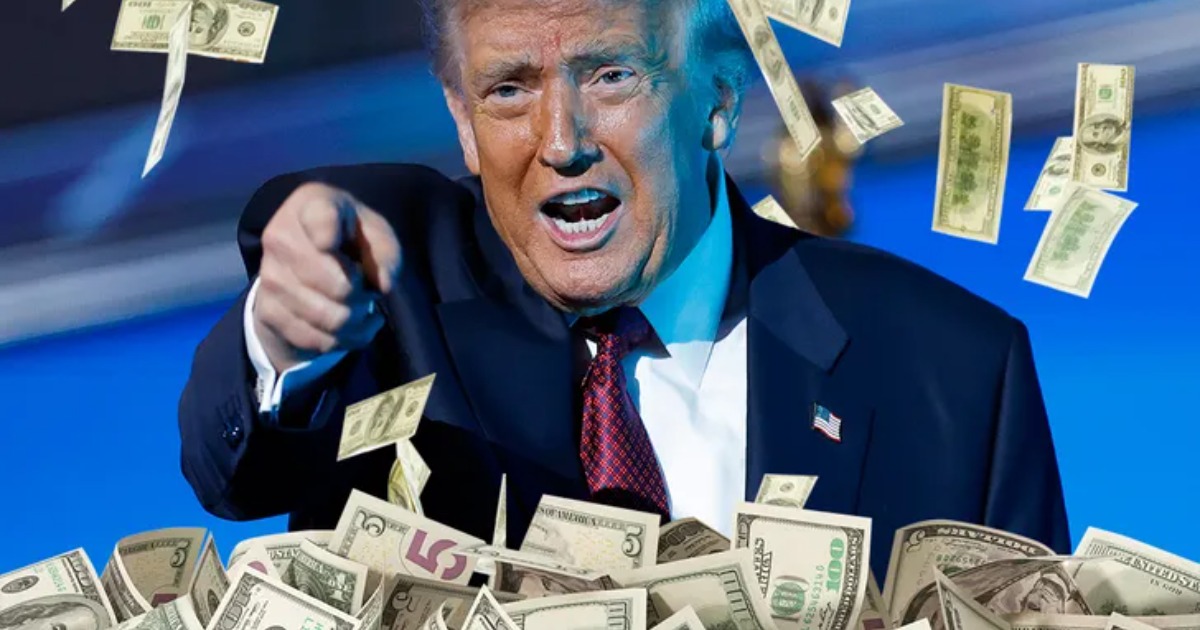

Millions of Americans hoping to receive a proposed $5,000 payment from President Donald Trump could face disappointment depending on the outcome of the upcoming midterm elections.
Trump has promised to issue what he calls a "Trump Dividend" to American adults if Republicans maintain control of Congress following the November 3, 2026, elections.
The proposed payment has attracted considerable attention, particularly among households struggling with rising living costs.
However, the initiative has not been approved by Congress, and no payment programme has been established.
There are also significant questions surrounding how the government would finance checks potentially costing more than $1 trillion.
Now, with the midterms approaching, Americans are wondering what would happen to the proposed payments if Republicans lost control of either the House of Representatives or the Senate.
What happens to the $5,000 Trump Dividend if Republicans lose?
If Republicans lose control of either chamber of Congress in the November midterm elections, Trump's proposed $5,000 dividend would face an additional major obstacle and could be abandoned or substantially changed.
Trump explicitly linked his promise to Republicans maintaining control of both the House and Senate.
During the Republican midterm convention in Dallas on September 9, he announced plans for a $5,000 payment to every adult American citizen if his party retained both chambers.
Therefore, a Republican loss would mean that the political condition Trump attached to the promise had not been met.
There would also be a significant legislative challenge.
Any new federal payment programme would need appropriate legal authority and funding approved through Congress.
If Democrats controlled the House, the Senate or both, they would gain considerable influence over whether such legislation could advance.
That could make the proposal much harder to implement, particularly if Democratic leaders opposed its cost or funding arrangements.
However, a Republican defeat would not automatically make the payments constitutionally impossible.
Congress could still approve a payment programme if sufficient lawmakers from both parties supported it.
The key distinction is that the dividend is currently a political proposal, not an approved benefit that Americans are legally entitled to receive.
Can Trump send the $5,000 checks without Congress?
President Trump cannot simply authorise a new nationwide $5,000 payment programme by executive order without an appropriate legal basis and congressional funding authority.
The US Constitution gives Congress control over federal spending.
Article I, Section 9 contains the Appropriations Clause, which requires federal money to be spent under appropriations established by law.
That principle is often described as Congress having the "power of the purse".
It means the president cannot independently withdraw enormous sums from the US Treasury for a new payment programme merely because he has announced it publicly.
Congress would need to authorise the spending through the appropriate legislative process, unless an existing law already provided valid authority for the payments.
For the proposed Trump Dividend, no such approved nationwide payment programme has been established.
That makes congressional cooperation essential to the plan's implementation.
What if Democrats take control of the House?
If Democrats win a majority in the House of Representatives, they would gain significant control over the chamber's legislative agenda.
House leadership determines which bills receive attention and how legislation progresses through the chamber.
A Democratic majority could decline to advance legislation establishing the proposed dividend.
Democratic lawmakers could also demand changes to the programme, including different eligibility requirements, a smaller payment or alternative funding arrangements.
Even if Republicans retained the Senate, a new spending programme would generally need approval from both chambers.
That means a proposal supported by the president and Senate Republicans could still fail in the House.
However, the outcome would depend on the positions taken by lawmakers rather than party control alone.
What if Democrats win the Senate instead?
A Democratic Senate majority would create a different legislative obstacle.
Even if Republicans retained control of the House, legislation establishing the dividend would still need to pass the Senate.
Senate leadership would influence which measures received consideration.
Additionally, many types of Senate legislation are subject to procedural rules requiring substantial support to advance.
Depending on how a dividend bill was structured, it could face further procedural hurdles.
Republicans might attempt to negotiate a bipartisan agreement or pursue an alternative legislative approach.
But neither strategy would guarantee that the proposal became law.
Would Americans still receive their checks if Republicans win?
Not necessarily.
Even if Republicans retain control of both the House and Senate, the proposed $5,000 payments are not guaranteed.
Trump's announcement was a conditional political promise, not legislation authorising payments.
The administration would still need to establish how the programme would operate, who would qualify and where the funding would come from.
Lawmakers would also need to consider the overall cost.
Some Republicans have expressed reservations about the proposal's affordability.
Therefore, maintaining congressional control would remove one political obstacle without resolving the programme's financial and legal challenges.
How much would the $5,000 checks cost?
One of the biggest concerns is the enormous amount of money required to fund the proposal.
Trump has suggested sending $5,000 to every adult American citizen.
With hundreds of millions of adults potentially eligible, the total cost could exceed $1 trillion.
Reporting by Reuters and Axios has estimated the cost at approximately $1.3 trillion, depending on the number of eligible recipients.
For comparison, that is substantially more than the annual budgets of many major federal government departments.
Funding such a programme would require a considerable source of government revenue, additional borrowing, reductions in other spending or some combination of those approaches.
Economists have also raised questions about whether large payments could contribute to inflation, depending on how they were financed and the wider economic conditions.
Where would the money come from?
Trump has suggested that revenue generated through tariffs could help finance the proposed dividend.
Tariffs are taxes imposed on imported goods.
When products enter the United States, importers generally pay the applicable tariff to the federal government.
Those costs can subsequently be passed on to American businesses and consumers through higher prices.
Although tariffs generate federal revenue, there is a substantial difference between the amount collected and the estimated cost of the dividend programme.
Axios reported in September that net tariff revenue for the fiscal year was approximately $154 billion at the time of its reporting.
That was far below the roughly $1.3 trillion estimated cost of sending $5,000 to every eligible adult.
As a result, tariff revenue alone had not been shown to provide sufficient funding for the promised checks.
Could the dividend increase the national debt?
If Congress approved the payments without identifying sufficient additional revenue or spending reductions, the programme could increase the federal budget deficit.
A larger deficit generally requires the government to borrow more money.
That borrowing contributes to the national debt.
Critics of the proposal have argued that a programme costing more than $1 trillion would create significant financial pressure.
Others support the principle of returning government revenue to households, particularly when Americans are facing high living costs.
Whether the programme would significantly affect inflation, consumer spending or economic growth would depend on its design and financing.
No detailed, independently assessed funding plan has yet established how the full cost would be covered.
Who would qualify for the $5,000 Trump Dividend?
Trump's original announcement referred to every adult American citizen.
That suggests the proposal is intended to cover US citizens aged 18 and over.
However, no final eligibility rules have been enacted.
It remains unclear whether payments would be subject to income limits, tax-filing requirements or other conditions.
There is also no confirmed procedure for determining how eligible recipients would receive their money.
Those details would need to be established before any nationwide payment programme could begin.
Americans should therefore avoid assuming that they qualify for a payment simply because they meet the broad description used in Trump's speech.
When would the $5,000 checks be sent?
No official payment date has been established.
Trump linked the proposed dividend to the outcome of the November 3 midterm elections.
However, winning an election would not immediately release money from the Treasury.
Legislation would first need to be approved and the relevant government agencies would need to establish a system for administering the payments.
Depending on the programme's design, that could involve verifying eligibility, identifying recipients and arranging direct deposits or paper checks.
There is currently no confirmed distribution schedule.
Can Americans apply for the Trump Dividend?
No official application process has been announced for the proposed $5,000 payment.
The programme has not been enacted into law.
That means there is currently no confirmed federal registration system for claiming the money.
Anyone encountering websites or social media posts promising early access should exercise caution.
Government payment announcements can attract scams designed to collect personal or financial information.
Americans should rely on official government sources for any future eligibility and application instructions.
Has Trump proposed dividend checks before?
Trump has previously discussed other forms of direct payments to Americans.
In 2025, he raised the possibility of distributing tariff-related rebate checks worth up to $2,000.
Another proposal involved potential $5,000 payments linked to savings identified by the Department of Government Efficiency.
Those earlier proposals did not result in the promised nationwide payments.
The latest $5,000 Trump Dividend is a separate proposal tied explicitly to Republicans retaining control of Congress in the 2026 midterms.
Its announcement has renewed questions about whether the federal government can finance large direct payments without increasing borrowing.
What has the White House said?
In a statement published on September 10, 2026, the White House promoted the dividend as a way for Americans to benefit from the administration's economic policies.
The statement repeated Trump's pledge to provide $5,000 to adult citizens if Republicans maintained control of the House and Senate.
The administration has argued that economic growth and tariff revenue could support the initiative.
However, the announcement did not establish an enacted funding programme or provide a confirmed date for distributing payments.
Those details remain unresolved ahead of the elections.
So will the $5,000 Trump Dividend actually happen?
At present, the payments remain a proposal rather than an approved government benefit.
A Republican loss in either chamber of Congress would undermine the condition Trump attached to his promise and could make the necessary legislation more difficult to pass.
However, it would not automatically prevent Congress from approving a similar payment programme in the future.
Even if Republicans retain both chambers, lawmakers would still need to address the enormous estimated cost, the source of funding and the legal framework for distributing the money.
The most important fact for Americans is that no $5,000 dividend checks have been authorised, and there is no guaranteed payment date.
Until legislation is passed and an official payment programme is established, the promised checks remain uncertain regardless of the midterm election results.
Sources: Reuters, September 9, 2026; Axios, September 10, 2026; White House, September 10, 2026; Congressional Research Service, Congress's Power Over Appropriations.