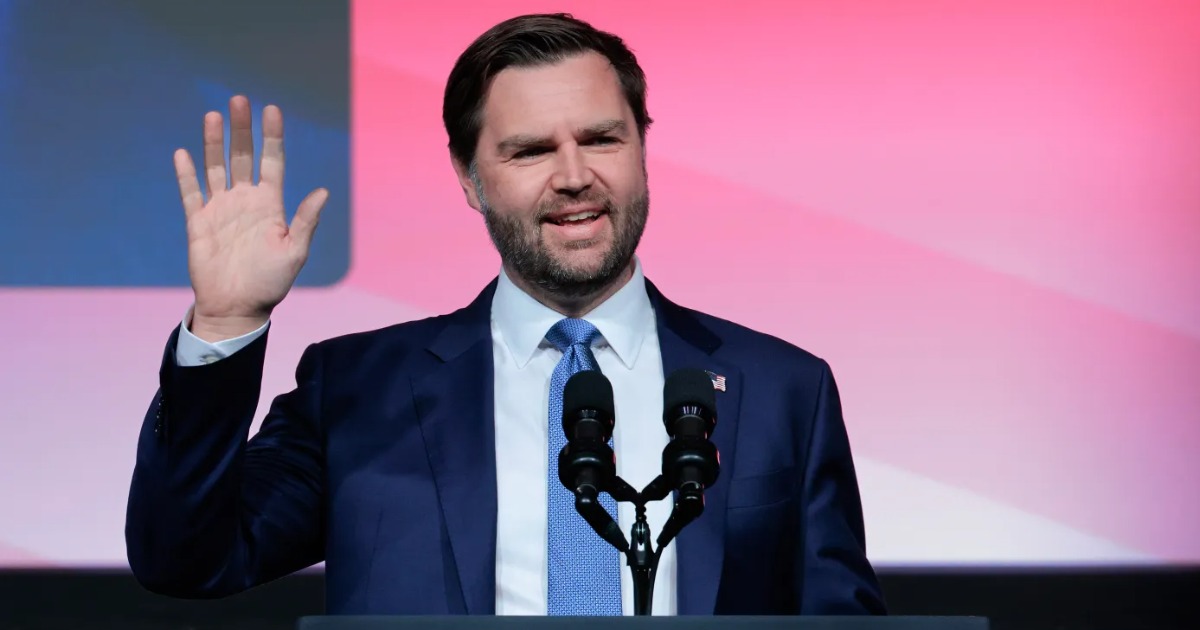

Vice President JD Vance has addressed Donald Trump's promise to send $5,000 checks to American adults, as the administration moves forward with separate payment initiatives ahead of the midterm elections.
With Americans facing continued concerns about the cost of living, Trump's proposed payments have attracted considerable attention. However, not everyone will qualify for the different schemes, and the largest payment remains uncertain.
During a Fox News town hall in Texas on Thursday (October 29), Vance was challenged by a voter who questioned whether the proposed $5,000 checks could contribute to inflation, much like the pandemic-era stimulus payments Republicans have previously criticized.
What did JD Vance say about the $5,000 checks?
Vance defended the proposal, arguing that Trump's planned payments were fundamentally different from the stimulus checks distributed during the Covid-19 pandemic.
He claimed that payments approved under former President Joe Biden had contributed to inflation, while describing Trump's proposal as a way of returning money to American taxpayers.
"It's really fundamentally a different idea," Vance said, according to The Wall Street Journal.
The vice president also suggested that the proposed payments could be funded through revenue generated by tariffs and penalties imposed on companies manufacturing products overseas.
However, the administration has not yet established a formal mechanism to distribute the $5,000 payments, and congressional approval would be required.
Who is eligible for Trump's $5,000 checks?
Trump has promised a $5,000 payment to every adult American citizen, provided Republicans retain control of both the House of Representatives and Senate in the November 3 midterm elections.
Under the proposal as announced, adult US citizens would be eligible regardless of whether they currently receive government benefits.
But the checks are not guaranteed. No application process has been announced, no distribution date has been confirmed, and Americans cannot currently claim the money.
Reuters previously estimated that distributing $5,000 to approximately 240 million adults would cost around $1.2 trillion, raising questions about how the government would finance the proposal.
What are the other payments being distributed?
Alongside the proposed $5,000 dividend, the Trump administration has announced two smaller payment initiatives, with distributions scheduled for October 2026.
The first involves a $90 payment for certain Medicare Part B beneficiaries. According to the White House, more than 20 million people could qualify.
Eligible recipients must generally have their Part B premiums paid directly rather than through Medicaid. Those enrolled in Medicare Advantage or paying income-related premium adjustments are excluded.
Payments were expected to be distributed through direct deposit or checks mailed to recipients' registered addresses.
The second initiative involves a $500 refund for certain Affordable Care Act marketplace customers.
Approximately one million Americans were expected to benefit, primarily people who purchase insurance through the federal marketplace without receiving premium assistance.
The refund applies to eligible customers in 30 states operating through the federal exchange, rather than every American with health insurance.
How can Americans claim the payments?
For the proposed $5,000 dividend, there is currently nothing to claim. Americans must wait for the administration to publish an official payment plan, assuming the proposal progresses.
Those wondering whether they qualify for the $90 Medicare payment can contact Medicare on 1-800-633-4227.
Recipients looking to check the status of a Medicare payment can contact the Social Security Administration on 1-800-772-1213.
For the $500 Affordable Care Act refund, eligible individuals should consult official marketplace communications rather than third-party websites claiming to process applications.
With the midterm elections just days away, Trump's largest promised payment remains dependent on the election result, further government action and congressional approval.
For now, Americans should be cautious of websites promising immediate access to the $5,000 checks, as no official claim process exists.