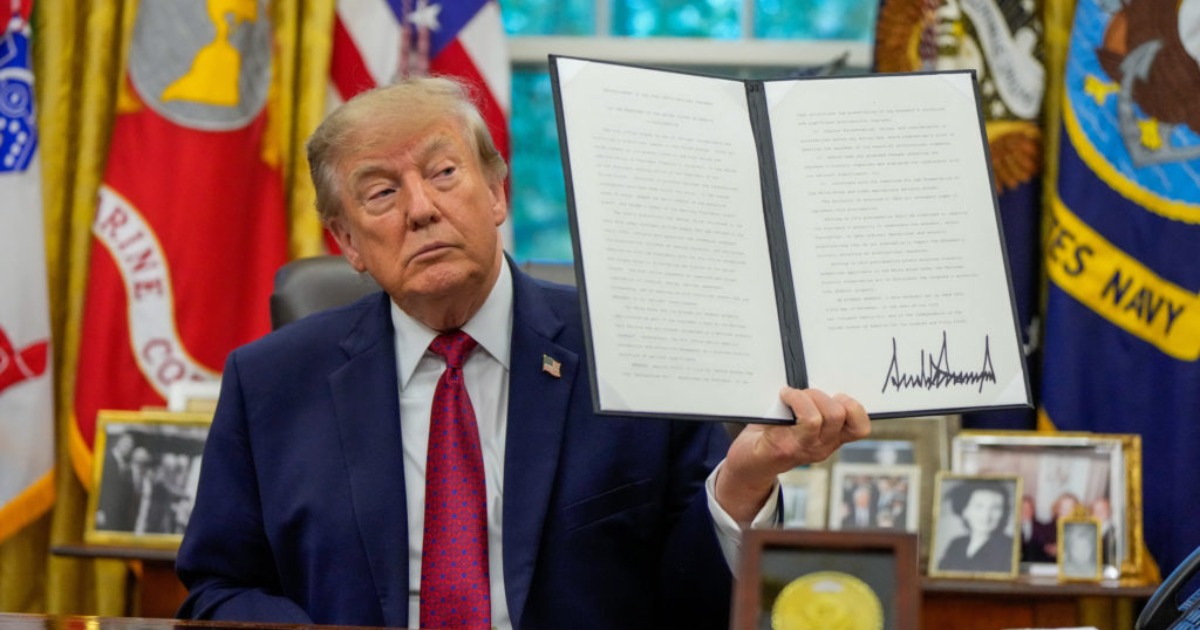
Donald Trump has signed a presidential proclamation declaring the Oval Office a national monument, in a move intended to protect the historic space from major alterations by future administrations.
The president announced the decision on Thursday, November 5, 2026, after spending much of his second term overseeing an extensive transformation of the White House's most recognisable office.
Since returning to power in January 2025, Trump has introduced numerous decorative features, restored items associated with his first presidency and made changes to other parts of the White House complex.
However, despite Trump's claims that the new designation will prevent future presidents from substantially changing the Oval Office, the official document contains an important exception.
What changes has Donald Trump made to the Oval Office?
One of the most noticeable changes has been the extensive introduction of gold decorations throughout the room.
Trump has added gold-coloured detailing to walls, doors and decorative mouldings, creating an appearance markedly different from the more restrained design seen during Joe Biden's presidency.
The president has also introduced ornate gold decorations around the fireplace, along with decorative flourishes above doorways.
Other additions include gold urns, vases, medallions and ornamental objects displayed throughout the office.
The changes reflect Trump's long-standing preference for elaborate interiors, a style also associated with several of his private properties.
Trump has filled the walls with presidential portraits
Another significant alteration involves the artwork displayed around the Oval Office.
Trump has increased the number of portraits hanging on its walls, including images of several prominent figures from American history.
Among those displayed are George Washington, Benjamin Franklin, Andrew Jackson, Ronald Reagan, Franklin D. Roosevelt and William Henry Harrison.
Many of the portraits are surrounded by elaborate gold frames that complement the room's other decorative features.
The president has also displayed a copy of the Declaration of Independence.
Presidents have traditionally selected artwork and historical objects that reflect their interests and priorities, meaning the Oval Office's appearance frequently changes between administrations.
Which decorations has Trump brought back from his first presidency?
Several familiar items returned to the Oval Office when Trump began his second term.
These include a bust of former British prime minister Winston Churchill, which had previously been displayed during Trump's first administration.
Military service flags have also returned to the office.
Another notable addition is Trump's well-known Diet Coke button.
The button, positioned on the Resolute Desk, allows the president to summon a member of staff to bring him a Diet Coke.
The feature became widely discussed during his first presidency and returned when he re-entered the White House in January 2025.
What other changes has Trump made around the White House?
Trump's renovation programme has extended beyond the Oval Office itself.
Outside the room, he has installed a large gold plaque identifying the Oval Office.
The president has also overseen changes to the White House grounds, including replacing the Rose Garden's lawn with a paved surface.
A new helicopter landing area has also been introduced.
Perhaps the most significant project involves the demolition of the White House's East Wing to make way for a proposed ballroom.
The ballroom project has attracted criticism and legal challenges, particularly over the approvals and preservation considerations associated with altering the historic complex.
Trump has defended the project as an improvement to the White House's ability to host major events.
He has also highlighted changes to the Cabinet Room, including the installation of chandeliers intended to improve its lighting.
What does Trump's new Oval Office proclamation actually do?
On November 5, Trump signed a proclamation titled "Establishment of the Oval Office National Monument."
The designation was made under the Antiquities Act, which allows presidents to designate certain historic landmarks and structures on federal land as national monuments.
The new monument covers the Oval Office itself, the Outer Oval Office and the Cabinet Room.
Under the proclamation, the Department of the Interior and National Park Service are directed to develop a management plan protecting the rooms' historic and architectural character.
Proposed changes that would substantially alter or demolish important architectural features must undergo documentation and review.
Speaking about the decision, Trump said he wanted to prevent future administrations from destroying or radically reshaping the historic office.
He argued that the Oval Office represents an important symbol of the United States and its presidency.
Can future presidents remove Trump's gold decorations?
Yes. Despite the new national monument designation, future presidents will still be allowed to redecorate the Oval Office.
The proclamation explicitly preserves a president's authority to select furnishings, change decorations and carry out ordinary operational or security modifications.
This means Trump's gold ornaments, portraits and other removable decorative features are not permanently protected by the designation.
A future president could choose a substantially different interior design without necessarily violating the proclamation.
The main focus of the new designation is protecting the rooms' architectural structure rather than preserving the particular decorative style chosen by Trump.
There is another important limitation: a future administration could seek to amend or reverse the proclamation itself, although the legal questions surrounding presidential authority over national monuments can be complex.
Does Congress have to approve future changes?
Trump suggested that substantial changes to the Oval Office would require congressional approval.
However, the actual proclamation does not establish a new requirement for Congress to authorise every major alteration.
Instead, it requires documentation, review and consideration of alternatives before changes that could substantially affect the monument's architectural character.
The document also explicitly preserves Congress's existing authority over federal property.
As a result, the protections are narrower than some of Trump's public remarks suggested.
Why does Trump want to preserve the Oval Office?
Trump has argued that the Oval Office is among the country's most important historical spaces and should be protected from major architectural changes.
He also claimed that parts of the room were in poor condition when he returned to the White House, citing damaged windows, walls and other features requiring attention.
The president has said that foreign leaders have complimented the office's appearance following his renovations.
However, the changes have also attracted criticism from those who believe the extensive decoration is excessive or question the administration's approach to historic preservation.
The new designation comes shortly after Republicans lost control of Congress in the November 3 midterm elections, with the incoming Democratic majority expected to scrutinise several of the administration's renovation projects.
Will the Oval Office stay this way after Trump leaves?
The Oval Office has undergone numerous transformations throughout American history, with successive presidents introducing their own furniture, artwork and decorative preferences.
Trump's proclamation creates additional preservation procedures for the historic rooms, but it does not permanently freeze their appearance.
Future presidents will remain free to replace furnishings, remove decorations and introduce their own designs, provided they comply with applicable requirements.
For now, Trump's gold-heavy redesign remains in place, but the next occupant of the White House will still have considerable freedom to make the Oval Office their own.
Sources: UNILAD, November 6, 2026; White House proclamation, November 5, 2026; Associated Press reporting.