A volcanologist has warned that the collapse of part of an Atlantic Ocean volcano could theoretically generate an enormous tsunami capable of reaching the United States.
Professor Bill McGuire has spent years studying the Cumbre Vieja volcanic ridge on La Palma, one of Spain's Canary Islands, where concerns about the stability of the island's western flank have prompted scientific debate.
The scenario involves a massive landslide sending rock into the ocean, displacing an extraordinary quantity of water and generating waves that could travel thousands of miles.
However, scientists disagree about how likely such a collapse is and how destructive the resulting waves would be.
Crucially, there is no evidence that a catastrophic collapse is imminent, and the warning should not be interpreted as a prediction of an approaching disaster.
Which parts of the US could be affected by a megatsunami?
McGuire's scenario focuses on the East Coast of the United States, with Florida among the areas identified as potentially vulnerable in extreme modelling.
According to the research discussed in BBC Science Focus, a catastrophic collapse of the volcano's flank could displace enough water to generate powerful waves travelling westwards across the Atlantic Ocean.
One worst-case model suggested that the initial displacement could create a water dome approaching one kilometre in height near the source.
That figure does not mean a kilometre-high wave would strike the American coastline. Waves change considerably as they travel across an ocean.
Nevertheless, some early simulations suggested that destructive waves could eventually reach the eastern United States.
Under one extreme scenario, the waves could cross the Atlantic in approximately nine hours, potentially creating significant challenges for coastal evacuation.
These figures come from disputed modelling assumptions rather than an established forecast of what would actually happen.
What warning has Professor Bill McGuire issued?
McGuire believes that a large section of La Palma's volcanic flank could eventually collapse into the North Atlantic.
Writing in BBC Science Focus, he explained that his expectation was based on geological studies of the island's structure and history.
He acknowledged that scientists have debated the possible consequences extensively, particularly whether a tsunami originating in the Canary Islands could remain destructive after crossing the Atlantic.
McGuire has also emphasised that he cannot predict when such an event might happen, suggesting it could be centuries or even thousands of years away.
His concern is therefore about a possible long-term geological hazard, not an identified emergency unfolding in November 2026.
The volcanologist argues that emergency planners should consider severe scenarios rather than automatically assuming the least damaging outcome.
How could a volcano cause a megatsunami?
Most people associate tsunamis with powerful underwater earthquakes, but enormous landslides can also displace water and generate destructive waves.
Volcanic islands are particularly relevant to this process because they can contain steep slopes and large quantities of rock above and below sea level.
If a sufficiently large section of an island were to collapse rapidly into the ocean, the displaced water could generate exceptionally large waves close to the collapse site.
These are sometimes described as megatsunamis, although the term does not have one universally agreed scientific definition.
Unlike ordinary wind-driven waves, tsunamis can carry energy across vast distances.
However, their behaviour depends on numerous factors, including the volume and speed of the landslide, the depth of the ocean and the shape of the seabed.
The size of the initial displacement does not directly establish the height of waves that would eventually reach distant coastlines.
Why are scientists concerned about La Palma?
La Palma is a volcanically active island in the Canary Islands, located off the northwestern coast of Africa.
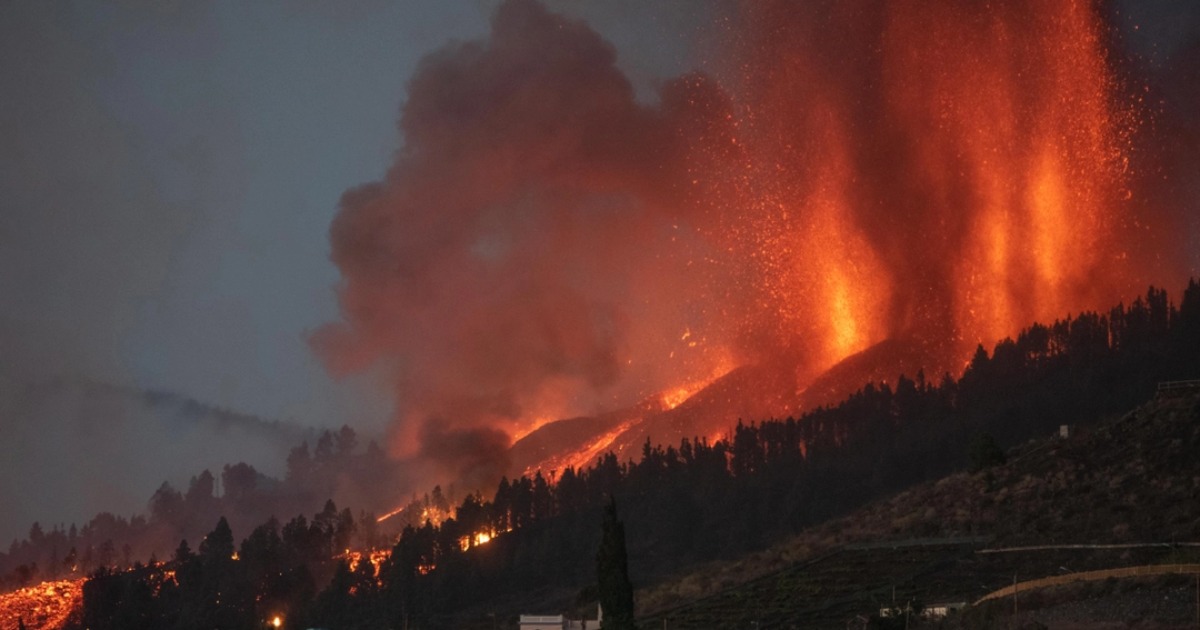
Its Cumbre Vieja volcanic ridge has experienced multiple eruptions, including a major eruption in 2021 that destroyed homes and infrastructure.
Researchers have investigated whether volcanic activity and geological stresses could eventually destabilise sections of the island.
Some studies have proposed that a sufficiently large collapse could trigger a transatlantic tsunami.
However, the scientific community has not reached a consensus that the specific large-scale collapse envisioned in early worst-case models is likely to occur.
The existence of an active volcano does not mean that its flank is currently undergoing an uncontrolled collapse.
Why do other scientists dispute the megatsunami theory?
Not all experts agree with McGuire's interpretation of the danger.
Earlier research suggesting an enormous transatlantic tsunami has faced criticism over its assumptions about the size, speed and behaviour of a potential landslide.
Some scientists argue that a future collapse, if one occurs, could happen in smaller stages rather than as a single enormous movement of rock.
That distinction is important because multiple smaller landslides could generate very different waves from one sudden catastrophic collapse.
The Tsunami Society has previously challenged sensational claims about a Canary Islands megatsunami, arguing that some public descriptions exaggerated the evidence.
Its criticism focused particularly on suggestions that a massive collapse and devastating transatlantic waves were inevitable.
Other modelling studies have also produced substantially smaller estimates of potential wave heights along distant coastlines.
Consequently, the most extreme predictions should be treated as hypothetical scenarios rather than established expectations.
Could a megatsunami reach the US within nine hours?
Some of the widely circulated models suggest that tsunami waves generated near the Canary Islands could reach parts of the American coastline in roughly nine hours.
That estimate reflects the speed at which long-wavelength tsunami waves can travel through deep ocean water.
However, travel time alone says nothing about how destructive those waves would be when they arrived.
A tsunami's impact depends on wave height, coastal geography, seabed conditions and how water behaves as it approaches shallow areas.
Furthermore, the nine-hour estimate applies to a hypothetical event that has not occurred.
There is currently no official tsunami warning associated with an impending collapse of La Palma.
Has anything like this happened before?
Large landslide-generated tsunamis are real geological phenomena, although the most extreme examples are often associated with confined bodies of water rather than waves crossing entire oceans.
In 1958, an earthquake-triggered landslide in Alaska's Lituya Bay generated a wave that stripped vegetation from slopes hundreds of metres above the water.
That event demonstrated how enormous local waves can result from rapid landslides.
However, it occurred in a narrow bay, making its behaviour very different from that of a tsunami travelling across the Atlantic.
McGuire has also pointed to large boulders found in the Bahamas that some researchers believe could have been transported by ancient tsunami activity.
The origin of those deposits remains debated, and they do not conclusively establish that a previous Canary Islands megatsunami reached the Americas.
Should Americans be worried about an imminent megatsunami?
There is no scientific evidence presented in the reporting that a catastrophic collapse of Cumbre Vieja is about to occur or that a megatsunami is currently heading towards the United States.
McGuire himself acknowledges that the hypothetical event could be extraordinarily distant in time.
The debate concerns how a rare geological event might unfold and whether its consequences could extend across the Atlantic.
Residents of coastal areas should rely on official alerts from the National Oceanic and Atmospheric Administration and the US Tsunami Warning Centers for information about genuine tsunami threats.
Emergency preparedness remains sensible in coastal communities, but speculative worst-case geological models should not be confused with an active emergency warning.
For now, La Palma remains an important subject of geological research, with scientists continuing to examine the potential risks posed by volcanic activity and large-scale landslides.
Sources: UNILAD, November 7, 2026; Professor Bill McGuire's commentary in BBC Science Focus; historical statements from the Tsunami Society; NOAA tsunami preparedness guidance.