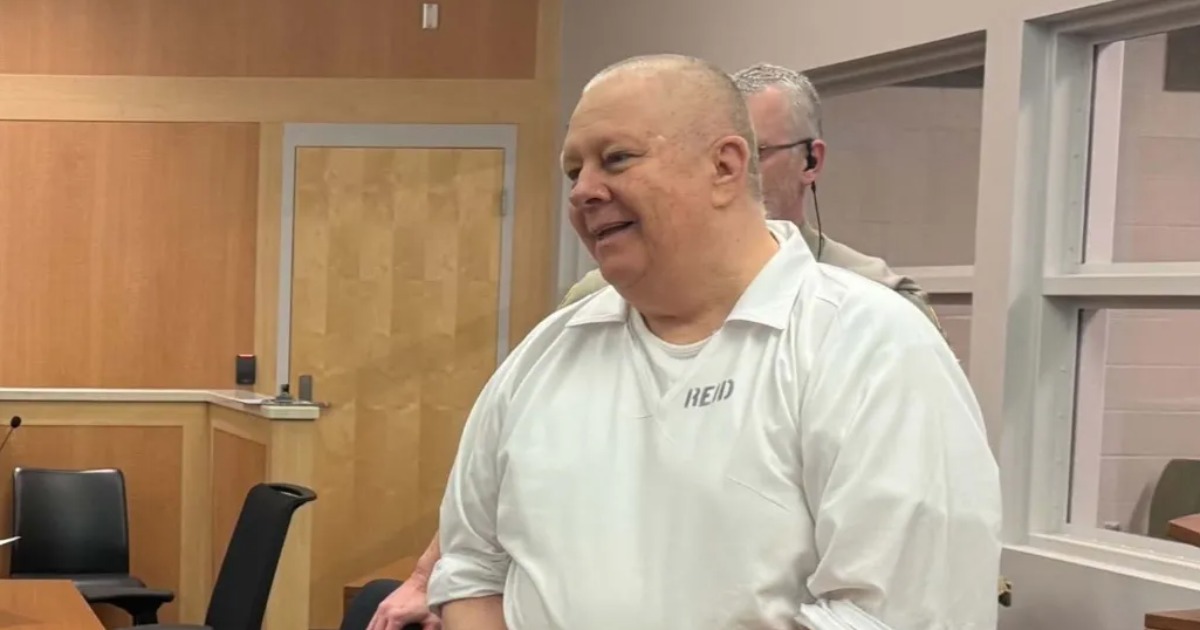

A man convicted of murdering his wife and adult daughter in Arkansas has received a significant change to his punishment, more than a decade after the killings.
Eric Reid, 66, was convicted of shooting dead his wife, Laura Reid, 57, and their daughter, Mary Ann Reid, 32, at the family's home in Hot Springs in October 2015.
His case has attracted renewed attention following an agreement reached in Garland County Circuit Court on Monday, October 26, 2026.
The development comes amid wider debate in the United States about capital punishment, its costs and the circumstances in which executions should proceed.
What happened to Eric Reid's death sentence?
Eric Reid's death sentence has been replaced with a life prison sentence following an agreement signed in Garland County Circuit Court on October 26, 2026.
Reid had originally been sentenced to death in March 2018 for murdering his wife and daughter.
However, according to a statement from the Execution Intervention Project, an agreement involving Reid's legal representatives resulted in the change to his punishment.
The decision means Reid will no longer face execution under the original death sentence.
Instead, he will remain imprisoned under the new sentence.
The reporting did not provide the full terms of the agreement or explain every legal consideration behind the decision.
What did Eric Reid do to his wife and daughter?
The case dates back to October 2015, when Reid shot and killed two members of his own family at their home in Hot Springs, Arkansas.
His wife, Laura, was 57 years old at the time of her death.
The couple's daughter, Mary Ann, was 32.
Reid was subsequently prosecuted for the killings and received a death sentence in March 2018.
More than a decade after the murders, the case returned to public attention following the latest development in court.
The deaths of Laura and Mary Ann remain at the centre of the case, regardless of the changes to Reid's punishment.
Who helped secure the agreement?
The Rev. Jeff Hood, founder of the Execution Intervention Project, was involved in efforts to secure the agreement alongside Reid's lawyers.
Hood, who lives in North Little Rock, Arkansas, is a prominent campaigner against capital punishment.
He has served as a spiritual adviser to numerous people facing execution and has worked with individuals on death row.
According to the organisation's announcement, Hood had also served as a spiritual adviser to Reid.
His involvement reflects his broader work challenging the use of the death penalty in the United States.
What did Jeff Hood say about the decision?
Following the agreement, Hood acknowledged the seriousness of Reid's crimes and the irreversible loss suffered by his family.
He made clear that the decision did not erase Reid's responsibility for killing Laura and Mary Ann.
However, Hood argued that carrying out an execution would not restore the lives of the two women.
In a statement released by the Execution Intervention Project, he said the state had chosen not to add another death to the case.
His comments reflected the organisation's opposition to capital punishment, while recognising the harm caused by Reid's actions.
Supporters and opponents of the death penalty continue to disagree about whether execution is an appropriate punishment for particularly serious crimes.
Why has the case attracted attention now?
Reid's case has resurfaced during a period of renewed discussion about executions in the United States.
According to the Arkansas Times, the decision came as authorities prepared for the planned military execution of Nidal Hasan, who was convicted of killing 13 people and injuring dozens more during the 2009 Fort Hood shooting in Texas.
The planned execution has attracted attention because the United States military has not carried out an execution since 1961.
The Arkansas Times also connected Reid's case to developments involving Christa Pike, a Tennessee inmate whose execution proceedings have generated controversy.
These separate cases have contributed to public discussion about the death penalty, including its administration, legal safeguards and consequences.
However, the source report does not establish that those other cases directly caused the change to Reid's sentence.
Why do death penalty cases cost so much?
One issue frequently raised in debates about capital punishment is the financial cost of death penalty proceedings.
Capital cases can involve lengthy trials, specialist legal representation, extensive evidence and multiple stages of appeal.
These requirements can make the overall legal process considerably more expensive than an ordinary criminal prosecution.
People sentenced to death may also spend many years in prison while their appeals and other legal challenges are considered.
Supporters of abolishing capital punishment argue that lengthy incarceration without execution can avoid some of these additional legal expenses.
Opponents of abolition argue that the death penalty should remain available for the most serious offences and emphasise punishment, accountability and justice for victims.
The costs and legal procedures vary considerably between states and individual cases.
Does the change mean Eric Reid could be released?
The agreement replaced Reid's original death sentence with a life sentence, but the Arkansas Times report did not set out the complete terms governing parole eligibility.
As a result, the source does not establish whether the new sentence formally includes or excludes the possibility of parole.
What is clear is that Reid remains subject to imprisonment for the murders of his wife and daughter.
The agreement does not overturn his convictions or suggest that he has been cleared of wrongdoing.
It changes the punishment imposed following those convictions.
What happens next for Eric Reid?
Following the agreement signed on October 26, Reid's original death sentence has been replaced by imprisonment for life.
The source report does not identify any further hearings or challenges scheduled in connection with the agreement.
The decision represents a major development in a case that began with the deaths of Laura and Mary Ann Reid in 2015.
For those involved in the campaign against capital punishment, it marks another example of a death sentence being changed through legal intervention.
For the victims' family and loved ones, however, the underlying tragedy remains unchanged.
Laura and Mary Ann lost their lives more than a decade ago, and no subsequent court decision can reverse those deaths.
The case continues to illustrate the difficult questions surrounding punishment, accountability and the use of the death penalty in the American justice system.
Source: Arkansas Times, Milo Strain, October 26, 2026; Execution Intervention Project statement, as reported by Arkansas Times.