
McDonald's has left people questioning everything they thought they knew about one of its most famous mascots after an unusual explanation of Grimace's identity resurfaced online.
The enormous purple character has been associated with the fast-food giant for decades, appearing in advertisements, promotional campaigns and alongside Ronald McDonald.
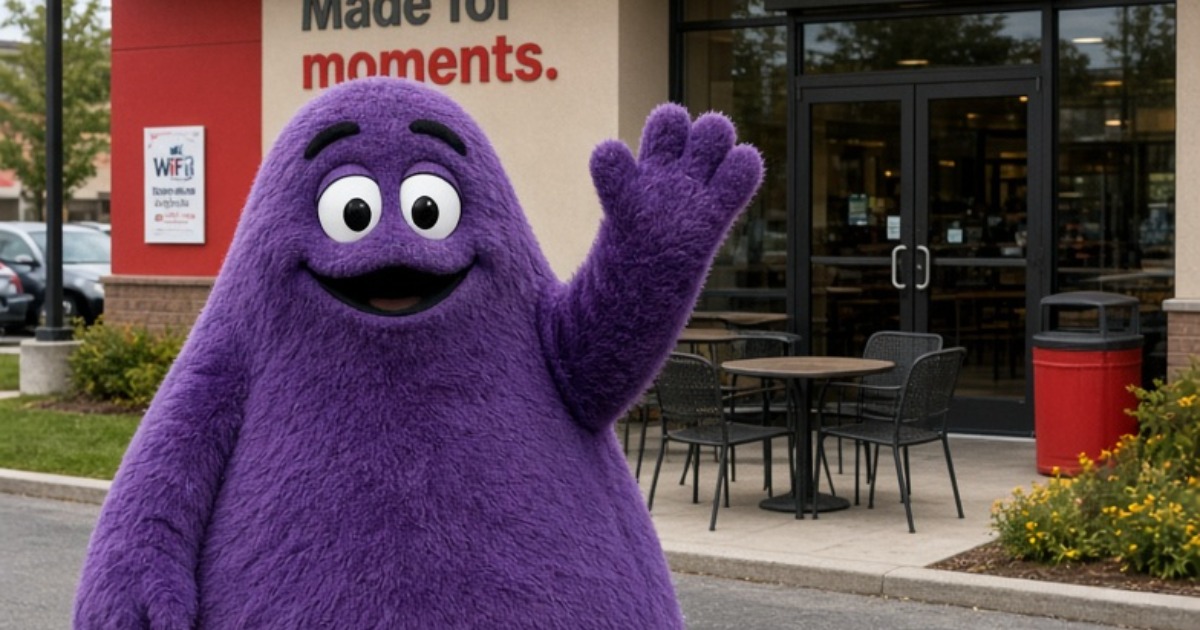
With his rounded body, enormous smile and unmistakable purple appearance, Grimace has become one of the company's most recognisable characters.
But despite his popularity, one surprisingly simple question has puzzled customers for years.
What exactly is Grimace supposed to be?
Now, comments from McDonald's representatives and a longtime employee have provided an answer that many people admit they never expected.
What is Grimace from McDonald's actually supposed to be?
According to an explanation given by a McDonald's manager in Canada, Grimace is supposed to represent an enormous taste bud.
The revelation came from Brian Bates, a McDonald's manager who discussed the character's identity during an interview with CBC News in 2021.
Bates described Grimace as a giant taste bud, explaining that the character was intended to represent how enjoyable McDonald's food tastes.
Although the explanation might sound bizarre, it offers a possible reason for the character's unusual appearance.
Unlike Ronald McDonald, who is clearly portrayed as a clown, Grimace has never resembled an immediately recognisable animal or person.
Instead, his large purple body and distinctive shape have encouraged fans to come up with their own theories about what he represents.
However, there is an important complication: McDonald's has not always provided one definitive explanation for the character.
McDonald's has given different explanations over the years
While the taste bud explanation has attracted considerable attention, the company has previously suggested that Grimace might represent something else entirely.
In 2012, a McDonald's corporate social media account suggested that the character embodied a milkshake, while acknowledging that some people believed he was a taste bud.
That statement appeared to leave the mystery unresolved.
Then, in 2021, McDonald's offered an even more open-ended explanation.
Speaking to People magazine, a company spokesperson said Grimace could mean different things to different people.
The spokesperson referenced several interpretations, including the idea that he might be a taste bud, a milkshake or simply a beloved purple character.
Rather than choosing one definitive identity, the company emphasised that Grimace's main purpose was to make people happy.
As a result, the widely shared taste bud explanation is best understood as one prominent interpretation rather than an entirely settled official definition.
People couldn't believe the explanation
Unsurprisingly, the idea that Grimace could represent a giant taste bud has prompted some extraordinary reactions online.
Many social media users admitted they had never questioned what the character was supposed to be.
Others said the explanation made the mascot seem considerably stranger than they remembered from childhood.
One person described the thought of Grimace being an enormous taste bud as frightening.
Another expressed disbelief, explaining that they had always assumed he was simply a cheerful purple character without any deeper meaning.
The confusion is understandable given how McDonald's has portrayed Grimace throughout his history.
His appearance does not closely resemble an anatomical taste bud, and the company has rarely focused on explaining his origins in modern advertising.
For many customers, Grimace has simply existed as a friendly mascot associated with the brand.
Grimace originally looked completely different
Although today's Grimace is known for his cheerful personality, the character's original appearance was considerably less welcoming.
He first appeared in McDonald's advertising in the early 1970s as a character known as Evil Grimace.
Rather than the friendly two-armed figure familiar to modern audiences, the original version had four arms and a much more intimidating personality.
He was portrayed as a villain who stole milkshakes and other drinks.
The character's appearance was also very different from the soft, rounded design used today.
Roy T. Bergold Jr., a former McDonald's vice-president of advertising, later discussed the original design in an interview with QSR Magazine.
According to Bergold, the early version of Grimace had a scaly appearance and lacked the charm needed to appeal to young children.
He explained that the mascot frightened children, creating a problem for a company attempting to build a family-friendly advertising campaign.
McDonald's eventually decided that the character needed a major transformation.
Why did McDonald's redesign Grimace?
The original version of Grimace was created as part of McDonaldland, a fictional world populated by characters used to promote the restaurant chain.
Alongside Ronald McDonald, the campaign featured figures such as Hamburglar, Mayor McCheese and the Fry Kids.
These characters helped create a recognisable world around the brand's food and restaurants.
However, a frightening villain was not necessarily the ideal mascot for young customers.
McDonald's gradually transformed Grimace into a friendly character with a gentler personality.
His four arms were reduced to two, his appearance became softer and his villainous behaviour disappeared.
Instead of stealing drinks, Grimace became a cheerful companion to Ronald McDonald.
The redesigned mascot was frequently portrayed as somewhat clumsy but good-natured, making him much more appealing to families.
Over time, this version became the Grimace that millions of people recognise today.
Why is Grimace purple?
Grimace's distinctive purple colouring has contributed to decades of speculation about his identity.
Some fans have suggested that the colour is connected to the appearance of certain milkshake flavours.
Others believe the unusual design was simply intended to make him stand out from other advertising mascots.
However, McDonald's has not consistently presented a single explanation connecting his colour to a specific food or biological feature.
The character's purple appearance has instead become an important part of his visual identity.
It makes him instantly recognisable even when he appears without any other McDonaldland characters.
How old is Grimace?
Grimace made his debut in McDonald's advertising in 1971.
That means the character has been part of the company's history for more than five decades.
His role has changed considerably during that time.
While he was initially introduced as an antagonist, he later became one of Ronald McDonald's most familiar companions.
As McDonald's advertising evolved, many of the original McDonaldland characters became less prominent.
Grimace, however, remained a recognisable part of the brand.
His enduring popularity has helped introduce the character to new generations of customers.
Grimace became a viral sensation again
Although Grimace is a character from the early 1970s, he experienced a major resurgence in popularity in 2023.
McDonald's launched a limited-edition purple milkshake as part of a campaign celebrating the character's birthday.
The promotion quickly attracted attention on social media.
TikTok users began posting videos featuring the drink, often turning the cheerful promotional campaign into exaggerated horror-themed sketches.
In many of the videos, people pretended that something strange had happened after drinking the purple shake.
The trend spread widely online, introducing Grimace to younger audiences who may not have been familiar with his earlier appearances.
The campaign demonstrated how a decades-old advertising character could still attract enormous attention in the age of social media.
What happened to Ronald McDonald?
Grimace is not the only McDonald's mascot whose public appearances have changed over the years.
Ronald McDonald, once a regular feature of the company's advertising, became less visible in certain campaigns and public appearances.
One notable development occurred in 2016, when reports of frightening clown sightings began spreading across several countries.
The phenomenon involved people dressing as clowns and appearing in public places, sometimes in circumstances intended to alarm passers-by.
Reports initially gained attention in the United States before similar incidents were reported internationally.
As concern about the sightings grew, McDonald's announced that it would exercise caution regarding Ronald McDonald's appearances at community events.
The company referred to the public climate surrounding clown sightings when explaining its decision.
However, Ronald McDonald was not formally eliminated as a character, and the reduced prominence of the mascot cannot be attributed solely to the 2016 incidents.
Does McDonald's officially consider Grimace a taste bud?
The answer is slightly more complicated than many viral headlines suggest.
The description of Grimace as an enormous taste bud came from a McDonald's manager and has been widely repeated.
However, McDonald's corporate statements have also entertained the possibility that he represents a milkshake or simply an imaginary purple character.
The company has therefore allowed some ambiguity to remain around the mascot's identity.
What is clear is that Grimace was created as a fictional advertising character rather than a scientifically accurate representation of anything found in the human body.
His unusual appearance, changing backstory and decades of advertising history have helped turn him into a character that continues to fascinate customers.
And for anyone who spent their childhood believing Grimace was simply a friendly purple monster, the giant taste bud explanation might make him seem a little more unusual than they remembered.
Sources: VT, August 6, 2025; CBC News, 2021; People, 2021; QSR Magazine; McDonald's historical advertising and promotional campaigns.