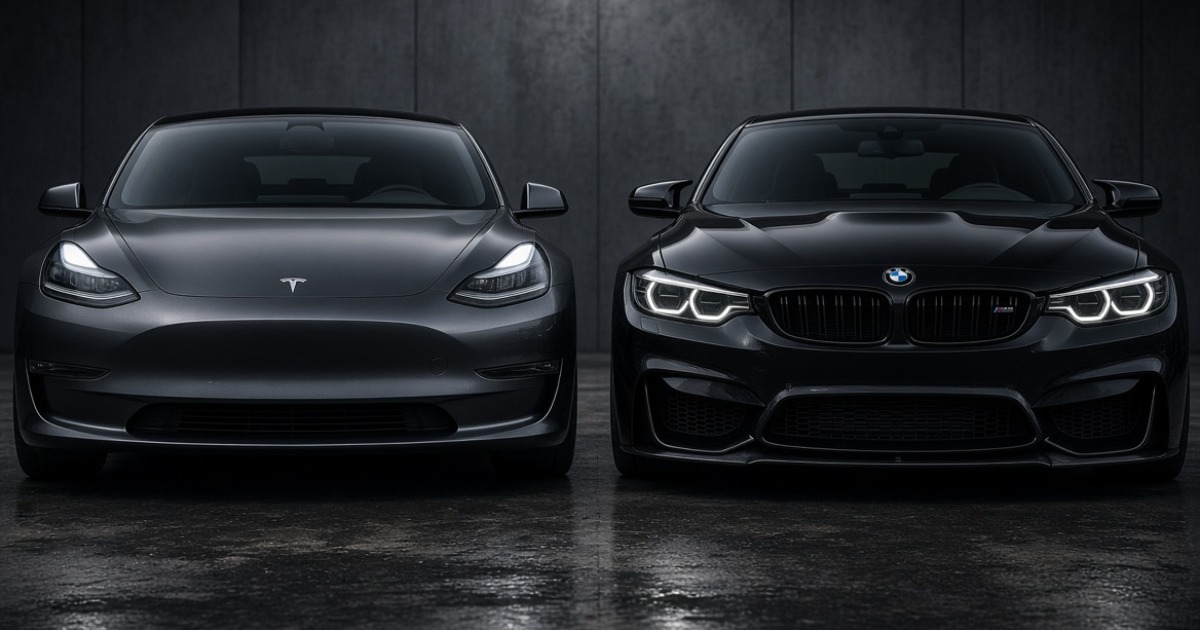

A Tesla owner has shared a detailed breakdown of how much he spent charging his electric vehicle over 75,000 miles, comparing the figure with the estimated cost of fueling his previous BMW.
Electric cars are often promoted as being cheaper to run than traditional petrol-powered vehicles, particularly when it comes to energy costs.
However, the actual savings can depend on several factors, including local electricity prices, charging habits and the cost of petrol.
One driver decided to put those claims to the test using years of real-world driving data.
Andy Slye, a YouTuber from Kentucky, tracked his Tesla Model 3's electricity consumption over six years and compared the results with what he estimated he would have spent driving a BMW 3 Series over the same distance.
How much did the Tesla cost to charge compared with the BMW?
According to Slye's calculations, charging his Tesla Model 3 for more than 75,000 miles cost just $1,404, compared with an estimated $9,353 in petrol for his previous BMW 3 Series.
That represents an estimated saving of $7,949 in energy costs over the six-year period.
The difference is particularly striking because both vehicles were compared across the same driving distance.
However, Slye acknowledged that his unusually low electricity costs were influenced by where he lived and the charging benefits available to him.
How much electricity did the Tesla use?
Slye explained that his Tesla Model 3 consumed approximately 18,656 kilowatt-hours (kWh) of electricity while driving more than 75,000 miles.
Once he accounted for additional energy lost during charging and consumed while the vehicle was idle, the total increased to approximately 20,728kWh.
He then used his electricity costs and Supercharger expenses to calculate the total amount spent over six years.
The resulting figure was $1,404, according to his records.
That works out at approximately 1.9 cents per mile in charging costs.
It is important to note that this was his reported personal cost rather than an average figure for all Tesla owners.
Why were his Tesla charging costs so low?
Slye acknowledged that electricity prices in Kentucky were relatively low compared with some other parts of the United States.
He also benefited from Supercharging credits, which reduced the amount he needed to pay out of pocket.
These advantages helped make his overall charging costs particularly inexpensive.
Drivers who regularly rely on expensive public fast chargers, or who live in areas with higher electricity tariffs, may spend considerably more.
Similarly, someone charging at home on a favourable overnight electricity tariff may be able to reduce their running costs.
Consequently, Slye's results demonstrate what was possible under his circumstances, but they should not be treated as a universal estimate.
How much would the BMW have cost in petrol?
For comparison, Slye estimated how much he would have spent fueling his previous BMW 3 Series over the same 75,000-mile distance.
Using the petrol price assumptions in his calculation, he arrived at an estimated total of $9,353.
That works out at approximately 12.5 cents per mile.
Compared with the Tesla's reported charging expenses, the BMW's estimated petrol costs were more than six times higher.
However, the BMW figure was a calculation rather than a record of actual petrol purchases over the same six-year period.
Changes in fuel prices, driving conditions and vehicle efficiency could affect the comparison.
What did viewers say about the comparison?
Slye's video prompted discussion among viewers, with some impressed by the reported savings and others questioning whether the same results could be achieved by typical motorists.
One viewer pointed out that 75,000 miles over six years represented a relatively modest annual driving distance.
Others raised questions about the potential long-term cost of replacing an electric vehicle's battery.
However, battery replacement is not automatically required after a fixed number of years, and actual battery lifespan varies depending on the vehicle and its usage.
Some commenters also suggested that electric vehicles may be more practical for people living near reliable charging infrastructure.
Drivers in rural areas with limited charging facilities could face additional challenges, particularly when travelling longer distances.
Does driving a Tesla really save money?
Electric vehicles can offer substantial savings on energy costs, particularly for drivers who can charge at home at competitive electricity rates.
However, charging expenses are only one part of the total cost of owning a car.
Other considerations include:
A Tesla may be cheaper to power than a comparable petrol vehicle while still costing more overall, depending on the purchase price and other expenses.
Likewise, someone with access to inexpensive charging and high annual mileage may find that an electric vehicle offers significant long-term savings.
What does the 75,000-mile comparison show?
Slye's experience provides an interesting example of how inexpensive electric motoring can be under favourable conditions.
His reported figures suggest that he spent nearly $8,000 less on electricity than he estimated he would have spent on petrol for his previous BMW.
But because the comparison excludes other ownership costs and includes charging credits, it does not establish that the Tesla was $8,000 cheaper to own overall.
For motorists considering switching to an electric vehicle, the most useful approach is to compare their own mileage, local electricity rates, charging access and vehicle costs.
Those individual circumstances will ultimately determine whether making the switch results in meaningful financial savings.
Source: VT, September 3, 2026, reporting on YouTuber Andy Slye's six-year Tesla Model 3 charging-cost comparison.