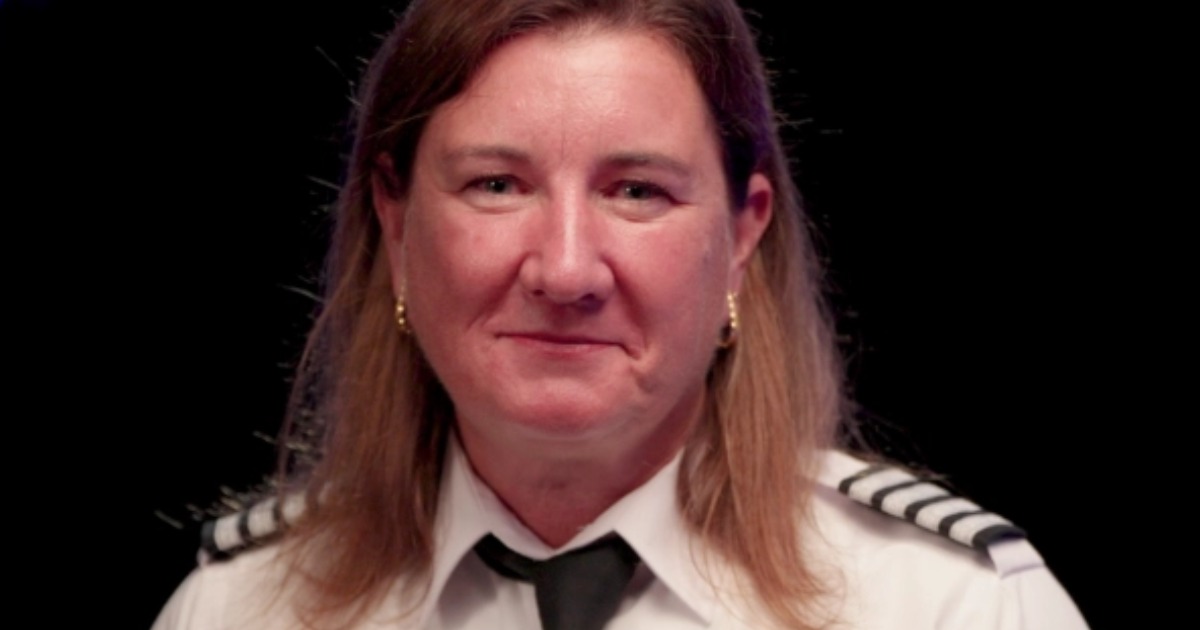
A former airline captain with more than 8,500 hours of flying experience has explained what pilots do when turbulence becomes particularly severe, including a specialised procedure that most passengers will never know exists.
Emma Henderson MBE, who spent much of her aviation career flying the Airbus A320, discussed the subject during LADbible's Explainer for a Stranger series.
Speaking to a nervous flyer named Serger, Henderson answered questions about what causes turbulence, how pilots prepare for it and whether rough conditions have ever frightened her.
She also revealed what can happen when the usual techniques for managing turbulence are no longer sufficient.
What is the worst-case scenario when a plane encounters severe turbulence?
According to Henderson, pilots can use a specific manual engine-thrust procedure to help maintain an appropriate flight condition during particularly severe turbulence.
She explained that, in an extreme situation, the crew may disconnect the aircraft's automatic thrust system and manually select a predetermined thrust setting.
"In the really worst-case scenario, there's a thrust setting that we can use," Henderson said.
"We can disconnect the auto thrust, go to manual thrust, set it at a certain place, and that is the speed and the thrust setting we need to ride out the turbulence."
Henderson emphasised that she had never personally needed to use that particular procedure, despite decades of flying experience.
The precise technique depends on the aircraft type, operating conditions and applicable flight procedures. It is not a universal setting used on every commercial aircraft.
Her explanation was intended to illustrate the preparations available to trained pilots, rather than suggest that turbulence routinely puts aircraft at risk of crashing.
Can severe turbulence cause a passenger plane to break apart?
Henderson was keen to reassure nervous passengers that modern commercial aircraft are designed to withstand substantial aerodynamic forces.
"Planes are really robust," she explained.
She said her confidence came from understanding the strength of the aircraft she operated and knowing the limits within which it was designed to fly.
Commercial aircraft undergo extensive structural testing and certification before entering passenger service.
However, that does not mean turbulence is entirely without risk. Extremely severe atmospheric conditions can place considerable stress on an aircraft, which is why pilots follow operating limitations and established procedures.
For passengers, the more immediate danger is generally injury from sudden movement inside the cabin.
What actually causes turbulence during a flight?
Turbulence occurs when an aircraft encounters irregular or rapidly changing air movements.
These disturbances can temporarily alter the airflow over the wings, causing passengers to experience bumps, jolts or changes in vertical motion.
Henderson explained that turbulence can develop for several reasons, including:
Clear-air turbulence can be particularly difficult for passengers to anticipate because it may occur while the sky appears completely calm.
It is often associated with strong wind shear near jet streams and other atmospheric boundaries.
How do pilots deal with turbulence?
Long before an aircraft takes off, pilots review weather information to identify areas where difficult conditions may be expected.
Henderson explained that crews can use this information to plan their routes and anticipate potentially turbulent sections of a journey.
If turbulence is encountered, pilots may reduce the aircraft's speed to an appropriate value for the conditions.
They may also request a different altitude or route if smoother air is available.
However, not every area of turbulence can be avoided.
"We might change altitude to try and find smoother air. We might just have to ride it out," Henderson said.
She also explained that air traffic controllers can pass on reports from aircraft flying ahead, giving following crews an opportunity to prepare.
What was the worst turbulence Emma Henderson experienced?
Despite spending thousands of hours in the cockpit, Henderson said she had encountered conditions severe enough to require immediate action from cabin crew.
On one occasion, she instructed flight attendants to stop what they were doing and sit down straight away.
The instruction was so urgent that crew members were not expected to return to their designated seats before securing themselves.
Henderson explained that the priority was getting everyone seated as quickly as possible to reduce the risk of injury.
Even during that experience, she said she had not feared that the aircraft itself would be unable to withstand the turbulence.
Why is wearing a seatbelt so important during turbulence?
Henderson's main advice to passengers was simple: keep your seatbelt fastened whenever you are seated, even when the sign is switched off.
Unexpected turbulence can occur without enough warning for passengers to secure themselves.
A sudden jolt may cause someone who is not restrained to be thrown against the ceiling, seats or other parts of the cabin.
Flight attendants are also vulnerable because their duties often require them to stand or move around the aircraft.
Henderson explained that when pilots receive reports of turbulence ahead, switching on the seatbelt sign allows passengers and crew to prepare.
While a seatbelt cannot eliminate every risk, wearing it correctly significantly reduces the chance of being thrown from a seat during sudden aircraft movements.
Has turbulence ever caused serious injuries or deaths?
Although serious turbulence-related incidents are uncommon, they can have devastating consequences.
Henderson referenced the Singapore Airlines flight in May 2024 that encountered severe turbulence while travelling from London to Singapore.
The incident resulted in numerous injuries and the death of a passenger.
The passenger's death was reported as resulting from a suspected heart attack, while other passengers and crew suffered injuries during the sudden movements.
The incident highlighted the importance of remaining securely seated whenever possible, particularly on long-haul flights where unexpected turbulence can occur.
Should nervous flyers be worried about turbulence?
Henderson said that understanding how aircraft are built and how pilots respond to difficult conditions had helped her remain confident throughout her career.
Her experience included approximately 8,500 flying hours, most of them aboard the Airbus A320.
She stressed that pilots receive training to manage turbulence and have access to weather information, operational procedures and support from air traffic control.
Although turbulence can feel alarming, the sensation experienced by passengers does not necessarily reflect the level of risk to the aircraft.
Her most practical recommendation was to keep seatbelts fastened while seated and follow instructions from the flight crew.
For nervous passengers, knowing that pilots have established procedures for even the most challenging conditions may offer some reassurance the next time a flight becomes unexpectedly bumpy.
Source: Tyla, November 6, 2026; Emma Henderson MBE speaking on LADbible's Explainer for a Stranger.