
A former US Secret Service agent has shared five warning signs that he believes can help people recognise when someone might not be telling the truth.
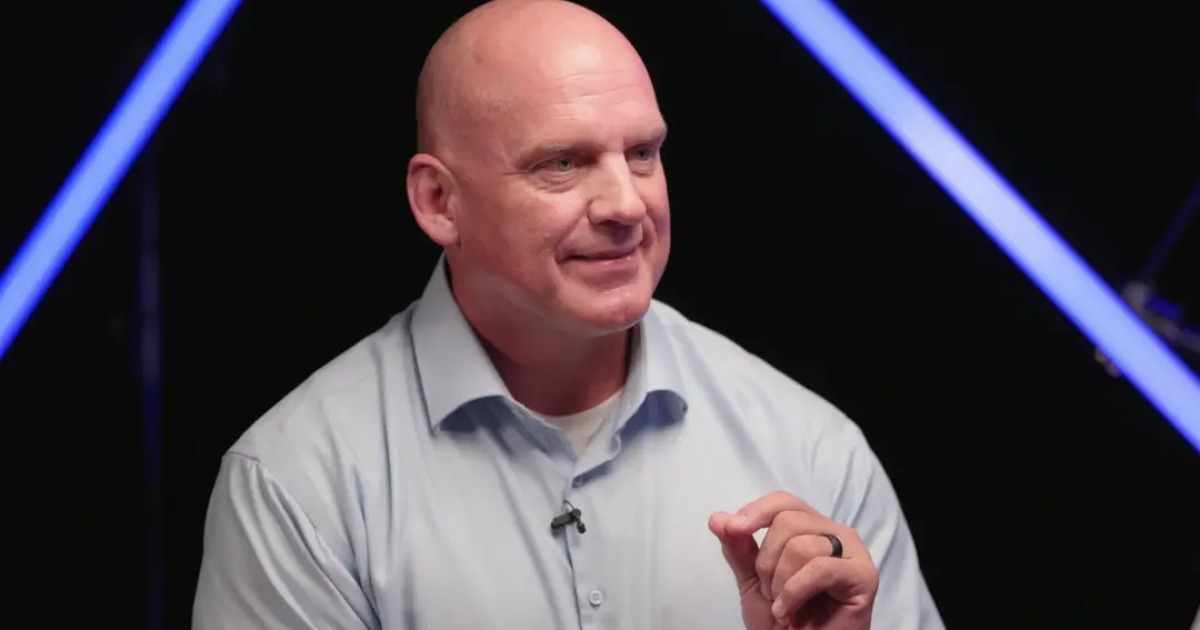
Brad Beeler, who spent 25 years working for the Secret Service and conducted numerous criminal polygraph examinations, discussed the subject during an appearance on LADBible Stories.
He explained that identifying potential dishonesty is not necessarily about watching someone's facial expressions or observing where their eyes move.
Instead, Beeler has developed a five-letter acronym designed to highlight behaviours he considers worth paying attention to.
What are the five signs someone could be lying?
Beeler's five warning signs are latency, incongruence, avoidance, resistance and shifting vocal inflection.
He combines these into the acronym LIARS, which he uses to explain the behaviours he looks for when assessing someone's responses.
However, these behaviours are not proof of deception. Nervousness, communication differences and other factors can produce similar responses even when someone is telling the truth.
1. Latency: Taking longer than expected to answer
The first warning sign is latency, which refers to the amount of time someone takes to respond after being asked a question.
Beeler suggests paying attention when a person appears to need an unusually long time to formulate an answer.
His reasoning is that someone recalling a genuine experience may be able to access details more naturally than someone attempting to construct a fictional account.
However, response time alone cannot reliably establish whether someone is lying, as people may pause to remember details, process a question or choose their words carefully.
2. Incongruence: When different signals do not match
The second warning sign is incongruence.
Beeler uses this term to describe situations in which someone's words and other responses appear inconsistent.
For example, someone might verbally agree with a statement while making a contradictory head movement.
He suggests that such inconsistencies can be worth exploring with further questions.
However, an apparent mismatch does not automatically indicate dishonesty.
3. Avoidance: Responding without answering the question
The third warning sign is avoidance.
This occurs when someone responds to a question but does not actually provide the information being requested.
They might change the subject, offer unrelated details or repeatedly speak around the issue.
Beeler considers the distinction between receiving a response and receiving a direct answer particularly important.
Nevertheless, people may avoid questions for reasons unrelated to lying, including discomfort, privacy or uncertainty.
4. Resistance: Becoming defensive when questioned
The fourth warning sign is resistance.
According to Beeler, this can involve someone reacting with offence or defensiveness when asked a question.
Rather than answering directly, the person may challenge why the question was asked or express frustration about being questioned.
Beeler identifies this as another behaviour that may warrant closer attention.
However, becoming upset or defensive is not reliable evidence of dishonesty, particularly when someone feels unfairly accused.
5. Shifting vocal inflection: When an answer sounds like a question
The final warning sign is shifting vocal inflection.
Beeler describes situations in which someone gives an answer with an unexpected change in their tone of voice.
For example, a person might respond to a straightforward question with a hesitant, upward inflection, making their answer sound more like a question than a statement.
He suggests this can sometimes indicate uncertainty about the answer being given.
However, vocal inflection varies naturally between individuals, accents and speaking styles, meaning it should not be treated as proof that someone is lying.
Why does the former Secret Service expert say body language can be misleading?
During the interview, Beeler also challenged some popular beliefs about detecting lies through body language.
One of the most common assumptions is that people who avoid eye contact must be hiding something.
Beeler disagrees with that interpretation.
He explained that people who are deliberately dishonest may actually maintain strong eye contact because they understand that avoiding it could make them appear suspicious.
Meanwhile, truthful people may struggle with eye contact because of nervousness, discomfort or their natural communication style.
He also dismissed the popular claim that looking in particular directions reveals whether someone is inventing a story.
According to Beeler, these commonly repeated body-language rules are unreliable indicators of truthfulness.
Why does Beeler compare truthful memories to a movie?
Beeler also described how he approaches the difference between recalling a real event and presenting a fabricated account.
He compared a genuine memory to a film that can be moved backwards and forwards.
His argument is that someone describing a real experience may be able to revisit different parts of the event and recall sensory or emotional details.
By contrast, he suggested that someone inventing a story might struggle when asked to move between different moments or provide additional details.
However, memory is not a perfect recording. Genuine memories can be incomplete or inaccurate, and confident accounts can also be false.
Can these five signs prove someone is lying?
Although Beeler presents LIARS as a useful framework for identifying potentially suspicious responses, no individual behaviour can establish deception with certainty.
Research into deception detection has repeatedly shown that behavioural cues are often weak or inconsistent.
Someone who hesitates, becomes defensive or avoids eye contact may still be entirely truthful.
Likewise, a person who speaks confidently and maintains eye contact may still be dishonest.
The most reliable approach is to consider the wider context, ask clear follow-up questions and check factual claims against independent evidence where possible.
Beeler's five-part framework offers a way to think about communication patterns, but it should not be used to make definitive accusations about someone's honesty.
Source: UNILAD, October 25–26, 2026, reporting on Brad Beeler's interview with LADBible Stories.