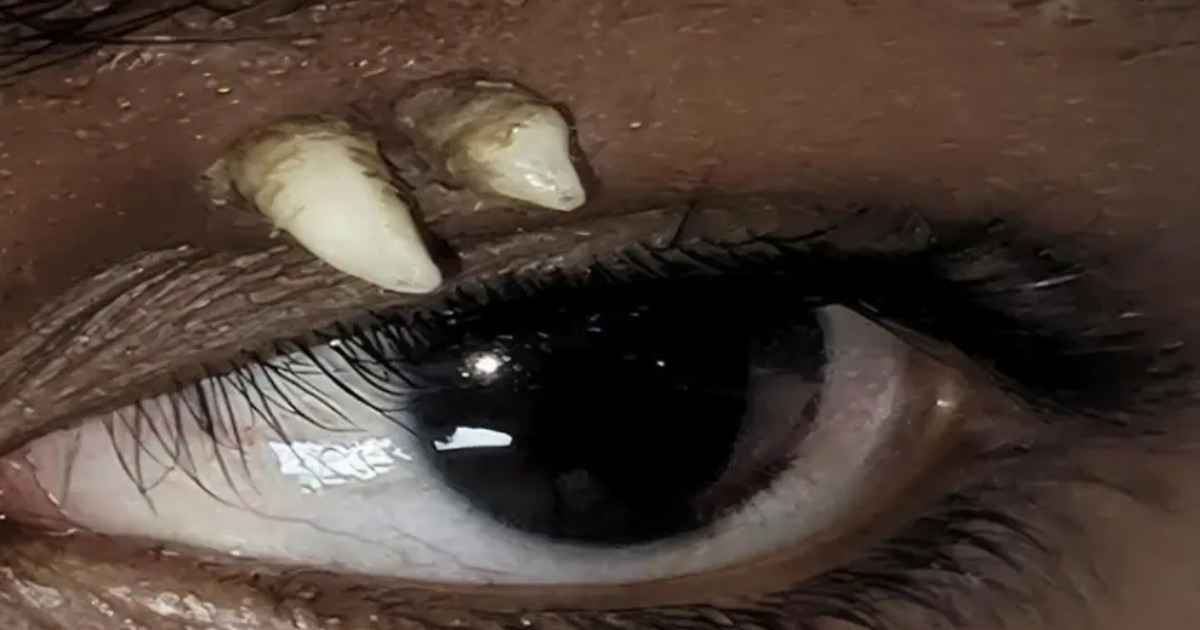

Doctors were confronted with an extraordinary medical case after discovering that a 16-year-old boy had developed a fully formed tooth inside his eye socket.
The teenager, from India, initially noticed swelling around his left upper eyelid, but experienced no pain or obvious discomfort.
After approximately a month, two small, hard, white projections began emerging through the skin near his eye.
Concerned by the unusual development, doctors carried out medical imaging to establish what was causing the swelling.
The results revealed something they rarely encounter: a canine tooth growing in a completely unexpected part of the skull.
How can a tooth grow inside someone's eye socket?
The condition is known as an ectopic tooth, which occurs when a tooth develops or erupts somewhere outside its normal position in the mouth.
During normal development, teeth form within the jawbones before eventually emerging through the gums.
However, in rare circumstances, a developing tooth can end up in an abnormal location.
This can happen because of developmental abnormalities, unusual positioning of the tooth germ, or disturbances affecting how teeth and surrounding facial structures form.
In some cases, trauma, infections, cysts or other conditions may also be associated with displaced teeth.
However, the exact cause is not always identifiable.
For the teenager in this case, doctors could not establish precisely why the tooth had developed near his eye.
Researchers reported that he had no history of trauma that could explain the unusual finding.
Importantly, the tooth did not grow from the eye itself. It was located within the bony structures surrounding the eye, an area known as the orbit.
What symptoms did the teenager experience?
According to the medical case report, the 16-year-old experienced swelling around his left upper eyelid for approximately one month.
Remarkably, the swelling was painless.
During their examination, doctors noticed two firm, whitish projections emerging from the affected area.
Further investigations revealed that the structures were part of a tooth.
Medical imaging showed the distinctive shape of a dental crown and root, confirming that the abnormal growth was a fully formed canine tooth.
The unusual position raised concerns because the eye socket contains delicate structures, including muscles, nerves and blood vessels essential for normal vision and eye movement.
Although the teenager was not experiencing significant discomfort, doctors determined that removal was appropriate.
Doctors successfully remove tooth from eye socket
The teenager underwent surgery to remove the ectopic tooth.
According to the published report, the procedure was successful.
The removal eliminated the abnormal tooth from the affected area and reduced the risk of complications associated with its unusual position.
The case attracted attention because ectopic teeth are rare, particularly when they develop within the orbital region.
Although abnormal teeth have been documented in several locations around the skull, finding one near the eye is especially unusual.
Where else can ectopic teeth grow?
While teeth normally develop within the upper and lower jaws, ectopic teeth have been reported in several unexpected locations.
These include:
The maxillary sinus is among the more frequently reported unusual locations.
Canine teeth are also commonly involved in cases of abnormal tooth positioning.
However, an ectopic tooth appearing in the eye socket remains exceptionally rare.
Another patient discovered a tooth growing inside his nose
The teenager's case is not the only example of a tooth appearing somewhere it should not.
Doctors previously documented the experience of a 38-year-old man who had suffered from breathing difficulties for years.
After undergoing medical investigations, doctors discovered that an ectopic tooth was growing inside his right nostril.
The tooth was positioned along the floor of the nasal cavity, obstructing normal airflow.
Following surgery to remove the misplaced tooth, the man's breathing problems improved.
The case demonstrated how ectopic teeth can sometimes cause symptoms that initially appear unrelated to dental health.
Do ectopic teeth always need to be removed?
Not every ectopic tooth requires surgery.
The decision depends on its location, whether it is causing symptoms and the potential risks associated with leaving it untreated.
Some ectopic teeth remain harmless and are discovered incidentally during scans performed for unrelated reasons.
In those circumstances, doctors may recommend monitoring rather than immediate removal.
However, surgical treatment may be necessary if the tooth causes pain, infection, swelling, cyst formation or interference with nearby structures.
In sensitive areas such as the eye socket, doctors must also consider the possibility of damage to surrounding tissues.
The benefits of removal are weighed against the risks of surgery in each individual case.
What makes this case so unusual?
The teenager's experience was remarkable for several reasons.
Firstly, the tooth developed in an extremely uncommon location, close to the eye rather than within the jaw.
Secondly, it had formed sufficiently to display recognisable crown and root structures.
And perhaps most surprisingly, the teenager experienced little discomfort despite the tooth beginning to emerge through the skin.
Doctors were able to identify the abnormal structure through imaging and remove it successfully.
The case serves as a reminder of how unusual human development can occasionally be, even in otherwise healthy individuals.
While ectopic teeth are rare and most people will never experience anything similar, persistent unexplained swelling or a hard growth near the eye should always be assessed by a medical professional.