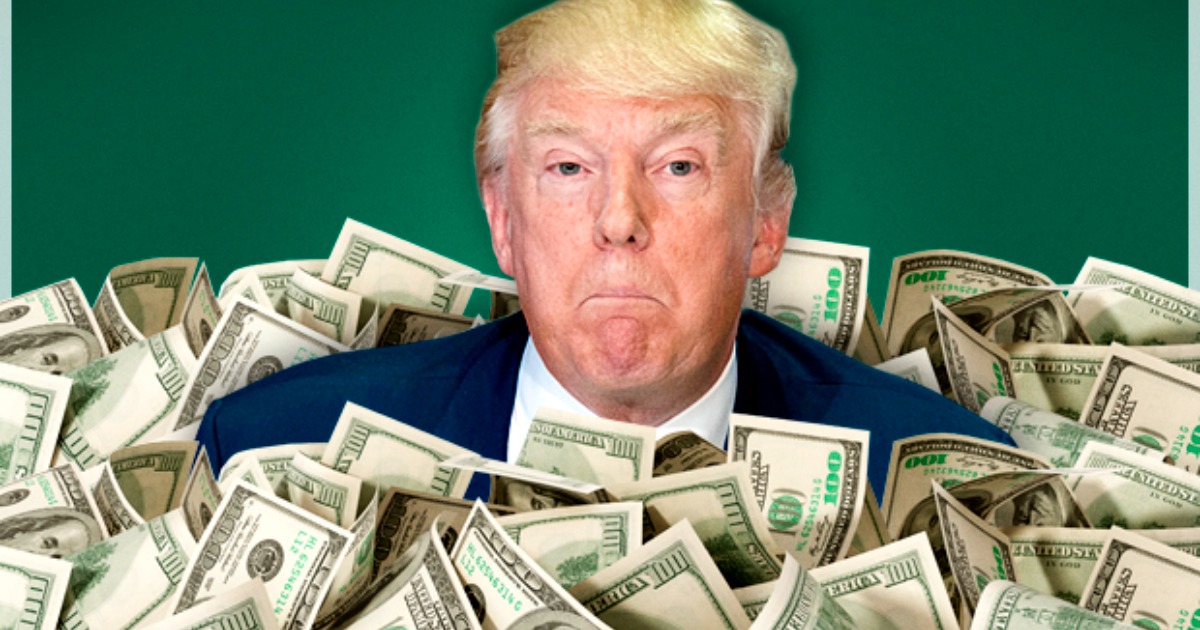

President Donald Trump has renewed his promise to send $5,000 payments to American adults if Republicans retain control of Congress in November's midterm elections.
But while the proposal could provide a substantial financial boost to millions of households, the president has revealed a restriction on how recipients would be allowed to spend the money.
Speaking at a campaign rally in Wasilla, Alaska, on October 13, Trump repeated his pledge to introduce what he calls the "Trump Dividend".
The proposal has generated widespread attention, although questions remain about its funding, eligibility requirements and whether the payments will ultimately be approved.
What is the condition attached to Trump's $5,000 checks?
Trump says Americans receiving the proposed $5,000 payments would be required to spend the money within the United States.
The president explained that he does not want the funds being spent overseas, arguing that keeping the money circulating domestically would benefit the American economy.
During his Alaska rally, Trump said recipients would receive their payments quickly after the election if Republicans won both chambers of Congress.
However, he stressed that the money must be spent in America rather than used for purchases or trips abroad.
He specifically mentioned China and Japan as examples of destinations where he did not want Americans spending their dividend payments.
The restriction has prompted questions about how the government could monitor where the money is spent.
As of November 1, no detailed enforcement mechanism has been publicly established, and it remains unclear whether recipients would receive ordinary checks, restricted payment cards or another form of payment.
Who would qualify for the $5,000 payments?
Trump has said that every adult American citizen would be eligible to receive the proposed dividend if Republicans retain control of both the House of Representatives and the Senate.
Under that promise, the payments would not be limited to households below a particular income threshold.
However, the administration has not published formal eligibility rules, meaning details such as income restrictions, residency requirements and the treatment of Americans living overseas remain uncertain.
The proposal is also explicitly conditional on the outcome of the November 3 midterm elections.
Republicans would need to retain control of both chambers for Trump to fulfil the political condition he has attached to the promise.
Where would the money come from?
One of the biggest questions surrounding the Trump Dividend is how the federal government would finance such an enormous payment programme.
Trump has suggested that economic growth, tariff revenues and increased investment in the United States would help make the payments possible.
He has estimated that the initiative could cost approximately $1 trillion.
However, government investment announcements and tariff revenue are not necessarily equivalent to money available for direct federal spending.
The administration has not released a detailed financing plan explaining how the payments would be funded without increasing borrowing or reducing spending elsewhere.
Economic analysts have also raised concerns about the potential impact of such a large programme on the federal deficit and inflation.
When would Americans receive the $5,000 checks?
Trump suggested during his Alaska speech that payments could be distributed relatively quickly following a Republican victory in November.
However, no official payment schedule has been announced.
The government has not opened an application process, established a distribution date or confirmed how Americans would receive the money.
A programme of this scale would also require legal and administrative arrangements, potentially including congressional approval for the necessary spending.
For now, Americans should not expect a $5,000 check to arrive automatically after Election Day.
Has Trump promised similar payments before?
The $5,000 proposal follows several previous announcements involving potential government payments to Americans.
Trump previously floated a $5,000 dividend connected to savings from the Department of Government Efficiency, commonly known as DOGE.
He also discussed a separate $2,000 tariff dividend.
Neither proposal resulted in the broad payments originally discussed.
By contrast, the administration distributed a $1,776 payment to eligible military personnel in December 2025, an initiative Trump has repeatedly cited when defending his ability to deliver financial bonuses.
However, that programme was considerably smaller than the proposed nationwide $5,000 dividend.
Will the $5,000 checks actually happen?
Despite Trump's repeated assurances, the payments remain a proposal rather than an approved government benefit.
There is currently no authorised programme allowing Americans to apply for or claim the money.
The president has continued promoting the dividend at campaign rallies, while some lawmakers and financial analysts have questioned its affordability.
The November midterm results will determine whether the political condition Trump has attached to the proposal is met.
Even if Republicans retain control of Congress, the administration would still need to establish a workable funding and distribution plan.
Until then, the $5,000 Trump Dividend remains an election promise, with its proposed domestic spending restriction one of several major details still requiring clarification.