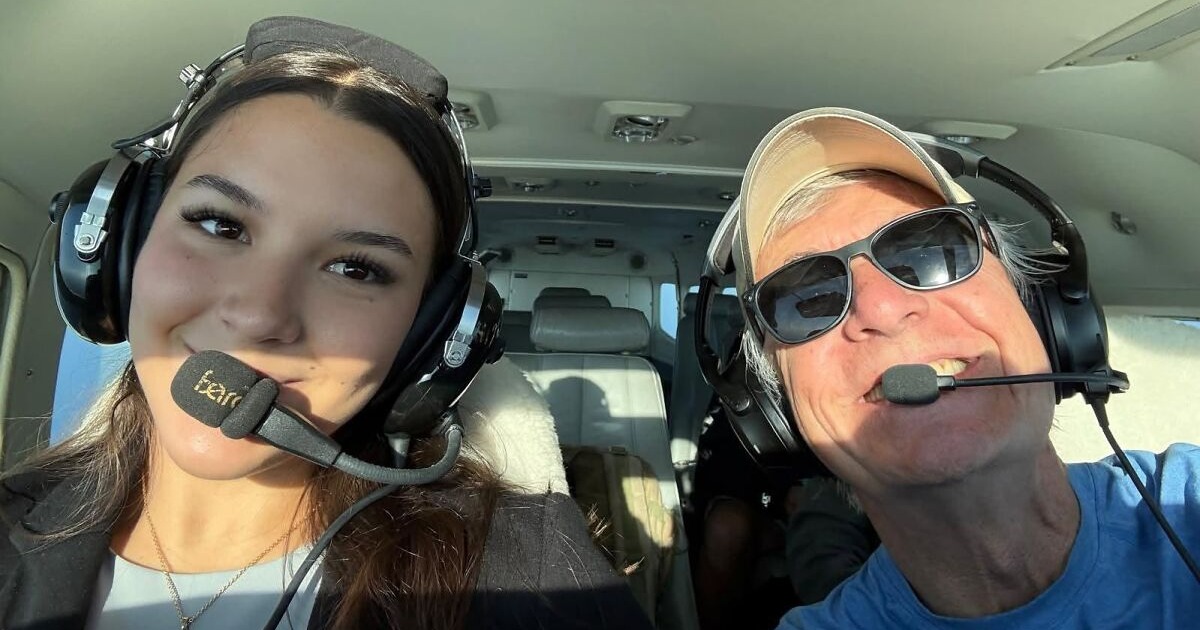
A neuroscientist has offered a heartbreaking explanation for why a 20-year-old co-pilot's microphone remained activated during the final moments of a private jet crash in Florida that killed nine people.
Nathalia Gadelha Filgueiras was serving as co-pilot aboard a Learjet 60 travelling from Austin, Texas, to the Bahamas when the aircraft lost control near Greenacres, Florida, on Sunday, November 1.
The jet was flying at approximately 35,000 feet before entering a rapid descent, reportedly losing more than 30,000 feet of altitude in just 76 seconds.
All nine people aboard were killed, including the two pilots and seven passengers, among them two young children.
Audio captured during the emergency has attracted widespread attention because it appears to contain exchanges between the pilots that would not ordinarily be heard by air traffic controllers.
Now, psychology commentator Derek Van Schaik has examined the recording and suggested why the co-pilot may have continued transmitting as the aircraft plunged towards the ground.
Why was the co-pilot's microphone left on during the crash?
Van Schaik, who holds postgraduate qualifications in psychology and forensic psychology, discussed the recording in a video examining the disaster.
He explained that the unusual audio appeared to have been captured because Filgueiras was continuing to hold down the aircraft's push-to-talk button.
This button allows pilots to transmit radio communications to air traffic control.
Normally, conversations between pilots inside the cockpit are not broadcast over the radio unless the transmission button is activated.
However, during the Learjet's final descent, the button apparently remained pressed, allowing parts of the crew's conversation to be heard outside the aircraft.
Van Schaik suggested that extreme psychological stress could explain why Filgueiras continued holding the button without realising it.
He explained that when people encounter an overwhelming emergency, their attention can become intensely focused on the immediate danger.
This can reduce awareness of smaller actions, including maintaining pressure on a button.
"Under intense stress, our attention narrows, making us less aware of less significant actions like maintaining our grip, holding down a push-to-talk button," he said.
According to this explanation, Filgueiras may have been so focused on the aircraft's rapidly deteriorating situation that she did not notice the radio was still transmitting.
However, Van Schaik emphasised that this was a possible explanation rather than an established finding about her state of mind.
The second explanation offered by the neuroscientist
Van Schaik also raised the possibility that the co-pilot had deliberately continued transmitting during the emergency.
He suggested she might have hoped that air traffic controllers could provide assistance or gain a clearer understanding of what was happening aboard the aircraft.
Alternatively, she may have wanted to ensure that the unfolding situation was recorded.
Van Schaik said: "She may have deliberately kept transmitting in hope that ATC could somehow help or subconsciously understand the importance of leaving a clear record of what was happening before they sadly crashed."
Both explanations remain speculative.
The publicly available radio recording cannot establish whether Filgueiras was consciously holding the button or whether she had become unaware of doing so.
What did the co-pilot say during the final moments?
The aircraft's final radio transmissions captured the crew attempting to manage an increasingly serious emergency.
Filgueiras could be heard reporting the aircraft's rapid descent as the pilots struggled to regain control.
At one point, the young co-pilot reportedly shouted: "Look outside."
Van Schaik highlighted the significance of this moment because it appeared to be directed towards the captain rather than air traffic control.
He noted that exchanges between pilots are normally captured by an aircraft's cockpit voice recorder rather than transmitted publicly over the radio.
The fact that this conversation could be heard by air traffic control made the recording particularly unusual.
Van Schaik also reflected on the emotional burden the crew may have faced as the emergency unfolded.
He pointed out that the pilots were responsible for seven passengers, including two very young children.
Although it is impossible to know precisely what either pilot was thinking, he suggested that awareness of the passengers' lives could have added to the psychological pressure of the situation.
What happened to the Learjet before it crashed?
The Learjet 60 had departed Austin-Bergstrom International Airport in Texas and was travelling towards the Bahamas.
During the flight, the crew encountered difficult conditions and reported problems as the aircraft began descending.
Radio communications indicated that the jet was losing altitude at an extremely high rate.
The crew declared an emergency, but the aircraft continued its descent before crashing into a residential area near Greenacres in Palm Beach County.
The impact caused extensive destruction and scattered aircraft debris across the surrounding area.
Emergency services responded to the scene, but all nine occupants were pronounced dead.
The National Transportation Safety Board subsequently launched an investigation to determine what caused the aircraft to lose control.
Investigators recover crucial wreckage nearly four miles away
Investigators have since made an important discovery that could help establish the sequence of events leading to the crash.
During a news conference on Tuesday, November 3, NTSB member Thomas B. Chapman confirmed that much of the aircraft's left elevator had been recovered in three separate pieces.
The components were found between approximately 1.3 and 3.8 miles from the main impact site.
The elevator is a movable control surface located on an aircraft's tail that helps pilots control its pitch, allowing the nose to move upwards or downwards.
The distance between the recovered pieces and the crash site indicates that at least some components separated from the aircraft before it struck the ground.
Chapman said the discovery was significant but cautioned that investigators had not determined whether the separation caused the aircraft to lose control or occurred as a result of forces already acting on the jet.
He also explained that the aircraft's extreme speed may have made recovery difficult even if the elevator had remained attached.
Weather conditions are another key focus of the investigation.
Who were the victims of the Florida Learjet crash?
The crash killed both members of the flight crew: 55-year-old Captain Jeff Gregory and 20-year-old co-pilot Nathalia Gadelha Filgueiras.
The seven passengers included technology entrepreneur Adam Robinson, his wife Helen Sharp and their two young children, Emma and Charlie.
The family was travelling with their nanny, Anita Maria Apellido Cetina, and two friends, Rachael Reed and Charmi Fehr.
The group had reportedly been heading to the Bahamas to celebrate Robinson's birthday.
Following the tragedy, relatives and friends paid tribute to the victims, remembering the family and the young pilot whose aviation career had only recently begun.
What happens next in the investigation?
The NTSB is continuing to examine the aircraft's wreckage, available communications, weather conditions and other evidence from the flight.
Investigators will seek to establish when the elevator separated, what caused the aircraft's rapid descent and whether mechanical or environmental factors contributed to the disaster.
The reason Filgueiras continued transmitting during the emergency has not been officially established.
Van Schaik's psychological analysis offers possible explanations for the unusual recording, but it should not be confused with findings from the federal investigation.
For now, the final radio transmissions remain a distressing record of the crew's efforts during the aircraft's last moments, while investigators continue working to establish what caused the tragedy.