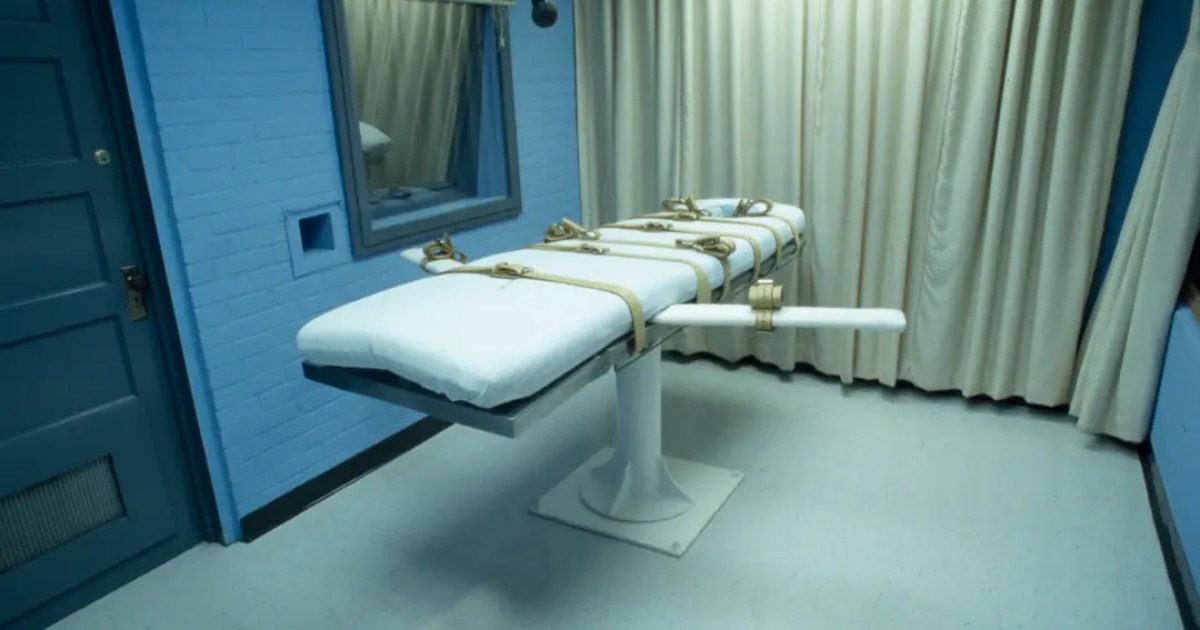

As Florida prepares to carry out another execution, attention has turned to one of the most secretive roles in the state's criminal justice system.
While the names and criminal histories of death row inmates are widely documented, considerably less is known about the people responsible for carrying out their sentences.
Florida protects the identity of its executioners, who are selected through a process overseen by prison officials.
But despite the extraordinary responsibility involved, the position comes with a fixed payment that may surprise many Americans.
The arrangements have attracted renewed interest ahead of the scheduled execution of 77-year-old William Reaves Jr. on October 20, 2026.
Who carries out executions in Florida?
Florida's Department of Corrections does not publicly identify the individual responsible for carrying out an execution.
According to the department's procedures, the executioner is considered a private citizen rather than a publicly identified prison employee.
The person's identity is protected, meaning members of the public are not told who performs the role.
The arrangement is intended to preserve confidentiality around those directly involved in administering capital punishment.
Executioners must also agree to maintain the secrecy of the process.
How are Florida's executioners selected?
The warden of Florida State Prison is responsible for selecting the executioner.
A Florida Senate report published in 1998 described the selection process, including the expectation that candidates demonstrate a willingness to participate in executions.
Those chosen are required to maintain confidentiality about their involvement.
Florida's procedures also provide for both a primary executioner and a secondary executioner.
The secondary individual can take over if the primary executioner is unable to carry out the assigned duties.
Unlike other government positions, the identities of the people selected are not ordinarily made public.
Who is William Reaves Jr.?
William Reaves Jr., 77, was scheduled to be executed in Florida on October 20, 2026, following his conviction for the murder of law enforcement officer Richard Raczkowski.
The killing took place on September 23, 1986.
According to court records, Reaves called 911 from a payphone outside a convenience store because he needed assistance arranging a taxi.
Raczkowski responded to the call and was attempting to help him when a firearm reportedly fell from Reaves' clothing.
A struggle followed, during which Reaves regained control of the weapon.
Prosecutors said Raczkowski attempted to flee before Reaves shot him four times in the back.
The officer subsequently died from his injuries.
Reaves was sentenced to death in 1987 and has spent decades challenging his conviction and sentence through the legal system.
Why have military veterans called for his execution to be stopped?
Reaves served in the Vietnam War, and his military background has become a significant part of the debate surrounding his death sentence.
More than 100 military veterans have reportedly urged Florida officials to reconsider carrying out his execution.
They have raised concerns about the psychological consequences of his wartime experiences, including post-traumatic stress disorder.
Supporters argue that his mental health struggles were not adequately presented to jurors during his original trial.
His former attorney, Chance Meyer, has suggested that Reaves believed he was fighting for his life during the confrontation with Raczkowski.
Those arguments have formed part of appeals for clemency, although they do not change the fact that Reaves was convicted of the officer's murder.
The case highlights ongoing debate about how the criminal justice system should consider severe psychological injuries associated with military service.
Why does Florida keep executioners anonymous?
Capital punishment remains one of the most controversial responsibilities carried out by state governments.
People involved in executions may face public criticism, personal scrutiny or safety concerns because of their participation.
Florida's confidentiality arrangements protect the identities of those carrying out the procedure.
However, critics of secrecy surrounding executions have argued that transparency is important when the government exercises its power to take a person's life.
The debate extends beyond the identity of executioners to questions about execution protocols, oversight and the methods used.
How many executions has Florida scheduled in 2026?
According to UNILAD's October 20 report, Florida was preparing to carry out its 18th execution of the year.
The number reflects a particularly active period for capital punishment in the state.
Executions in the United States are administered under individual state laws and procedures, meaning practices differ considerably across jurisdictions.
Some states have abolished the death penalty, while others continue to impose and carry out death sentences.
Florida remains among the states that permit capital punishment.
How much does Florida pay its executioner per execution?
According to the Florida Department of Corrections information cited by UNILAD, the state's executioner receives $200 for each execution carried out.
The payment is made through the state prison system and is a fixed fee for performing the role.
That means the individual responsible for carrying out a death sentence receives just $200 for the procedure, despite the extraordinary responsibility involved.
Florida also maintains a secondary executioner who can take over when required, although the reporting does not establish whether that individual receives the same payment when serving in a backup capacity.
The identities of both individuals remain confidential.
Source: UNILAD, October 20, 2026, citing Florida Department of Corrections information and historical Florida Senate reporting.