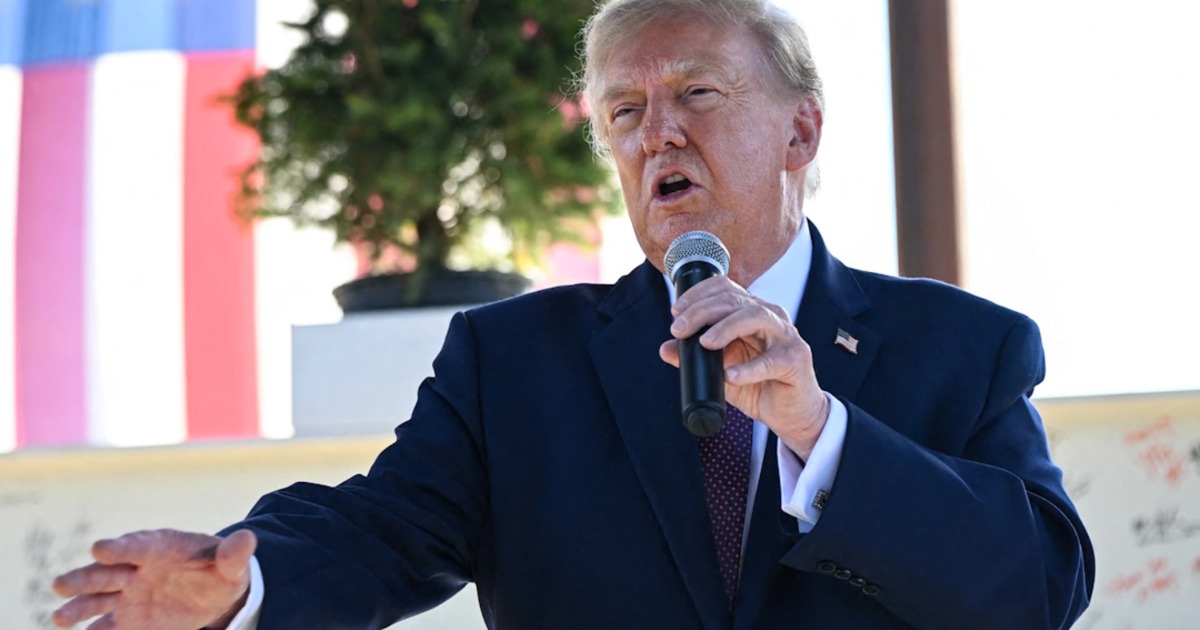
A clinical psychologist has raised questions about an unusual movement Donald Trump appeared to make during his first public appearance following the Republican Party's defeat in the 2026 midterm elections.
The president addressed reporters on Wednesday, November 4, after Democrats secured control of both the House of Representatives and the Senate.
While Trump discussed the election results, the conflict with Iran and construction of a new White House ballroom, one particular moment caught the attention of a psychologist who regularly analyses public appearances by political figures.
Dr John Paul Garrison, a clinical and forensic psychologist known online as Dr. G Explains, reviewed footage of the president holding a hard hat during the event.
He highlighted a brief sequence involving Trump's face and arms, suggesting that the movements deserved closer attention.
What unusual movement did the psychologist notice?
During his analysis, Garrison focused on footage showing Trump holding a hard hat while speaking about the White House construction project.
The psychologist claimed that the president appeared to make sudden movements involving his mouth and arms.
He suggested that the movements did not appear deliberate, based on his interpretation of the footage.
Garrison said he had previously noticed what he considered unusual movements during other Trump appearances.
He also explained that the president's behaviour immediately before and after the moment contributed to his interpretation.
However, whether the movements were involuntary cannot be established from the footage alone.
What did the psychologist suggest the movement could mean?
Garrison went on to discuss several possible neurological explanations for movements of the kind he believed he had observed.
He mentioned focal aware seizures, certain forms of dementia, vascular conditions and the potential effects of a previous stroke as examples of conditions that can sometimes involve unusual movements.
These were speculative possibilities raised by the psychologist, not confirmed medical findings about Trump.
A focal aware seizure is a type of seizure in which a person remains conscious and aware of their surroundings. Depending on the part of the brain involved, symptoms can include unusual sensations or involuntary movements.
Some neurological conditions can also affect movement, coordination or muscle control.
However, similar-looking movements may occur for many other reasons, including ordinary gestures, temporary muscle contractions or responses to physical discomfort.
Garrison has not publicly established that Trump experienced a seizure, stroke or any form of dementia.
His commentary is based on publicly available video rather than a clinical examination.
There is no confirmed evidence from the footage that the president has any of the neurological conditions discussed.
Can a psychologist diagnose a neurological condition from video footage?
Although clinical psychologists are trained to assess behaviour and mental health, diagnosing neurological conditions such as epilepsy or stroke generally requires appropriate medical evaluation.
Doctors may use a combination of medical history, neurological examinations, imaging and other investigations to establish the cause of unusual movements.
Video recordings can sometimes provide useful information to clinicians, particularly when they capture a symptom that is not present during an appointment.
However, short public clips do not provide the full clinical information needed to establish a diagnosis.
Garrison is not Trump's treating physician, and his observations should be understood as commentary rather than a medical assessment of the president.
What happened during Trump's first appearance after the midterms?
Trump's November 4 appearance came after a difficult election night for Republicans.
Democrats won control of both chambers of Congress, changing the political balance ahead of the new congressional session in January 2027.
During the event, Trump discussed construction of the White House ballroom, a project that has attracted considerable political attention.
He also addressed the administration's conflict with Iran and its possible effect on the midterm results.
Trump acknowledged that the war may have influenced voters but continued to defend his administration's decisions.
The president maintained that preventing Iran from obtaining nuclear weapons remained a central objective of his foreign policy.
What did JD Vance say about the Republican election defeat?
Vice President JD Vance also commented on the Republican Party's losses, pointing to the war with Iran as a significant factor.
In a lengthy social media statement, Vance argued that the conflict had influenced the election outcome and that Republicans needed to acknowledge its political consequences.
When reporters asked Trump about the vice president's assessment, he did not publicly reject it.
Instead, the president said he understood Vance's position and continued defending the administration's approach towards Iran.
The exchange came as Republicans began assessing the reasons behind their electoral setbacks.
What have other observers said about Trump's appearance?
Garrison was not the only commentator to examine the president's appearance following the election.
Body language expert Judi James also offered her interpretation of the footage, suggesting that Trump appeared tired and frustrated.
James pointed to aspects of his facial expressions, voice and gestures that she believed indicated fatigue.
However, body language analysis is subjective and cannot reliably establish someone's health, emotional state or medical condition.
Neither James' observations nor Garrison's commentary constitutes independent medical evidence of an underlying illness.
Has Donald Trump been diagnosed with a neurological condition?
There is no publicly confirmed diagnosis establishing that Trump has a seizure disorder, dementia or neurological damage from a stroke.
Previous official medical statements have described the president as being in good or excellent health, although those assessments do not independently resolve every question raised about his public appearances.
The latest commentary has renewed discussion about the health of political leaders, particularly as Trump continues his second presidency at the age of 80.
Nevertheless, a brief movement captured on camera is not sufficient evidence to conclude that a person has a neurological illness.
For now, Garrison's interpretation remains an unverified assessment of publicly available footage.
Any reliable conclusion about the president's neurological health would require appropriate medical evidence rather than speculation based on a single public appearance.