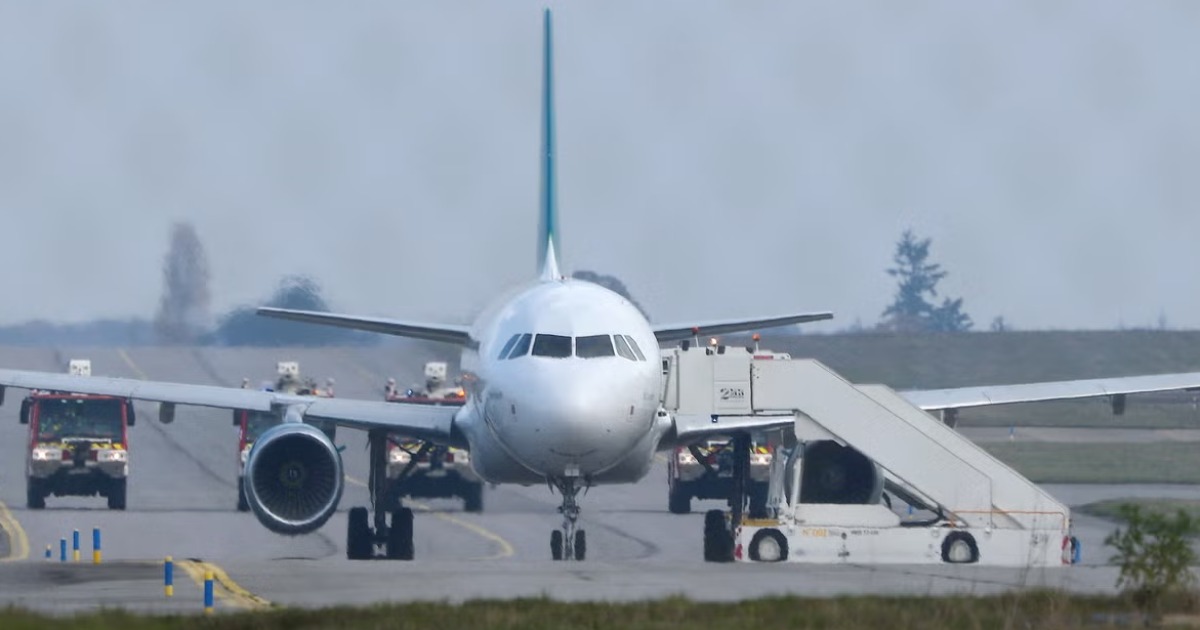
Dozens of passenger flights across Europe have been targeted by bomb threats in a matter of days, forcing emergency landings, military escorts and widespread security operations as experts raise concerns about possible "hybrid warfare".
At least 27 flights were affected on Thursday, November 5, alone, according to Reuters, following another wave of threats earlier in the week.
The incidents have affected major European airlines, including Ryanair, Aer Lingus, Wizz Air, Finnair and LOT Polish Airlines.
Some aircraft were diverted while already airborne, others were intercepted or escorted by fighter jets, and several were searched after landing.
Although authorities have not discovered explosives in the aircraft inspected so far, the unusual concentration of threats has prompted questions about whether the incidents could be connected.
Aviation security specialists have also raised the possibility of a wider campaign intended to disrupt essential services across Europe.
What is hybrid warfare?
Hybrid warfare refers to the use of a combination of conventional and unconventional tactics to weaken, intimidate or destabilise another country without necessarily engaging in direct military conflict.
Such tactics can include cyberattacks, sabotage, disinformation campaigns, interference with critical infrastructure and other activities designed to create disruption and uncertainty.
Unlike traditional warfare, which typically involves direct military confrontation, hybrid operations can be difficult to attribute to a particular government or organisation.
They may also be designed to remain below the threshold that would ordinarily provoke an armed military response.
In the context of aviation, a coordinated campaign of false bomb threats could potentially force airlines to divert aircraft, disrupt airports and require authorities to deploy expensive emergency resources.
Even when no explosive device exists, the disruption can be substantial.
However, investigators have not established that the latest European aviation threats form part of a state-sponsored hybrid warfare campaign.
Why are experts concerned about the bomb threats?
Eric Schouten, head of aviation security organisation Dyami, told Reuters that the incidents should be considered against the wider geopolitical situation in Europe.
He suggested that security specialists must examine whether hostile actors could be attempting to disrupt multiple sectors of European infrastructure.
Schouten pointed to previous incidents affecting railways, supermarkets, energy systems, internet infrastructure and aviation.
Several European governments have previously accused Russia of involvement in suspected sabotage and hybrid attacks.
However, there is currently no public evidence establishing that Russia, or any other state, is responsible for the latest aircraft bomb threats.
Russia has denied involvement in previous allegations of hybrid attacks.
Matthew Borie, an aviation security specialist at Osprey Flight Solutions, has also outlined several possible explanations for the incidents.
These include copycat threats, a single individual or group issuing multiple warnings, or a more organised campaign involving state-linked actors or their supporters.
Authorities are continuing to investigate the source of the warnings.
Which flights have been impacted by the bomb threats?
The wave of threats has affected flights across the United Kingdom, Ireland, France, Spain, Italy, Poland, Denmark, Bulgaria, Romania, Austria, Belgium and the Czech Republic.
According to Reuters, the Associated Press and European authorities, the following routes were among those affected between November 2 and November 5.
Flights affected on Thursday, November 5
Spanish authorities also reported several threats involving Air Europa and Iberia flights connected to Madrid, Paris, Rome and Milan.
Additional alerts were reported at Copenhagen Airport and involving aircraft arriving at Milan Malpensa.
Not all affected flights were diverted, and some threats were received while aircraft were still on the ground.
Flights affected earlier in the week
The latest incidents followed a separate series of threats beginning on Monday, November 2.
Authorities reported no explosive devices on the aircraft inspected in these earlier incidents.
Why were fighter jets scrambled to intercept passenger planes?
One of the most serious incidents occurred on Thursday when an Aer Lingus Airbus A320 travelling from Dublin to Rome was diverted to a French military airbase.
The aircraft was carrying 151 passengers and six crew members.
French authorities deployed fighter jets after the bomb threat was reported, with the aircraft eventually landing at Evreux in Normandy.
Reuters reported that the French prime minister's office said the pilot had not cooperated with authorities as expected during the incident.
No explanation for that behaviour was immediately provided.
Military bomb disposal teams were deployed to inspect the aircraft, while passengers and crew were moved to safety.
Fighter jets were also deployed in separate incidents involving aircraft travelling to Bulgaria and Italy.
Such interceptions can allow military authorities to monitor an aircraft, communicate with its crew and respond to potential threats while the situation is assessed.
Have any actual bombs been found?
Despite the large number of alerts, authorities have not reported finding explosives or other hazardous materials on the aircraft inspected so far.
Officials have described the threats as hoaxes, although investigations into their origins remain ongoing.
British authorities have also described threats involving UK-connected flights as malicious.
However, airlines and airport security teams cannot simply disregard warnings because previous incidents have turned out to be false.
Security procedures may require aircraft to divert, passengers to disembark and specialist teams to examine the aircraft and baggage.
These precautions are designed to protect passengers and crew while authorities determine whether a warning is credible.
Could the bomb threats be linked to Russia?
Some aviation security experts have raised concerns about the possibility of state-linked interference because the threats have occurred alongside other suspected acts of sabotage in Europe.
Countries including Denmark, Poland and Romania have previously accused Moscow of involvement in hostile activities targeting European infrastructure.
However, there is no confirmed link between Russia and the latest aviation bomb threats.
Reuters reported that no country had publicly attributed responsibility for the incidents as of November 5.
Investigators are also considering explanations unrelated to state activity, including individual hoaxers, online groups and copycat behaviour.
The apparent timing and geographical spread of the threats may be unusual, but those factors alone do not establish that the incidents were coordinated by a foreign government.
Why can false bomb threats cause so much disruption?
Even when a threat turns out to be false, its consequences can be significant.
An aircraft may need to land at an alternative airport, potentially requiring additional fuel, emergency services and accommodation or alternative travel arrangements for passengers.
Security teams may have to unload baggage, evacuate passengers and inspect the aircraft before it can return to service.
These procedures can delay subsequent flights and disrupt airline schedules across several countries.
Aviation security specialists have suggested that a single serious incident can result in substantial financial losses for an airline.
If multiple flights are targeted within a short period, the combined disruption can place additional pressure on airport operations and emergency resources.
This is one reason why security experts are examining whether the threats are simply isolated hoaxes or part of a wider attempt to create disruption.
Is it safe to fly in Europe right now?
European authorities have not issued a general warning that commercial air travel is unsafe because of the incidents.
All the aircraft reported in the latest bomb-threat cases have landed safely, and no explosives have been discovered during the reported searches.
Airlines and security agencies have established procedures for responding to threats, including coordination with police, air traffic controllers and military authorities when necessary.
Passengers travelling through affected airports may nevertheless experience delays, diversions or additional security checks.
Anyone with an upcoming flight should check directly with their airline for the latest information about their journey.
What happens next?
Investigations are continuing across several European countries to establish who issued the threats and whether individual incidents are connected.
Authorities are sharing security information as they examine the pattern of warnings and the methods used to deliver them.
For now, the incidents remain a series of serious security disruptions rather than a confirmed campaign of hybrid warfare.
While the absence of explosives has provided reassurance, the scale of the disruption has raised questions about how easily European transport networks can be affected by coordinated or repeated false alarms.
Whether the threats originated from individual hoaxers, organised groups or a more sophisticated operation remains to be determined.